

 English
 русский
 Deutsch
 Türk
 中文简体
Industrial Standard L-Ring Kinetic Seal for Reliable Reciprocating Applications
Industrial Standard L-Ring Kinetic Seal for Reliable Reciprocating Applications
Industrial Standard L-Ring Kinetic Seal for Reliable Reciprocating Applications
Industrial Standard L-Ring Kinetic Seal for Reliable Reciprocating Applications
Industrial Standard L-Ring Kinetic Seal for Reliable Reciprocating Applications
Industrial Standard L-Ring Kinetic Seal for Reliable Reciprocating Applications
Industrial Standard L-Ring Kinetic Seal for Reliable Reciprocating Applications
Industrial Standard L-Ring Kinetic Seal for Reliable Reciprocating Applications
Industrial Standard L-Ring Kinetic Seal for Reliable Reciprocating Applications
Industrial Standard L-Ring Kinetic Seal for Reliable Reciprocating Applications
Industrial Standard L-Ring Kinetic Seal for Reliable Reciprocating Applications
Industrial Standard L-Ring Kinetic Seal for Reliable Reciprocating Applications
Industrial Standard L-Ring Kinetic Seal for Reliable Reciprocating Applications
Industrial Standard L-Ring Kinetic Seal for Reliable Reciprocating Applications
Industrial Standard L-Ring Kinetic Seal for Reliable Reciprocating Applications
Industrial Standard L-Ring Kinetic Seal for Reliable Reciprocating Applications

Shen Ruolan — After-Sales Technical Consultant
Home / Author / Shen Ruolan — After-Sales Technical Consultant / Industrial Standard L-Ring Kinetic Seal for Reliable Reciprocating Applications
NEW Category
Contact us
Industrial Standard L-Ring Kinetic Seal for Reliable Reciprocating Applications
Content
- 1 Product Overview and Application Purpose
- 2 Key Technical Specifications
- 3 L-Shaped Profile for Dynamic Sealing
- 4 Material Characteristics of NBR
- 5 Advantages in Comparison with Less Specialized Seals
- 6 Manufacturing Quality and Process Strengths
- 7 Design Considerations for Equipment Engineers
- 8 Applications in Industrial Automation
- 9 Dry-Run Performance and Maintenance Value
- 10 Why Manufacturing Partnership Matters
- 11 Installation and Validation Recommendations
- 12 Performance Benefits for Production Users
- 13 Limits and Responsible Product Selection
- 14 Frequently Asked Questions
- 14.1 What type of product is the A-2-002?
- 14.2 What are the main dimensions?
- 14.3 What rod and housing arrangement is specified?
- 14.4 What material is used?
- 14.5 Is the product suitable for reciprocating motion?
- 14.6 What does the 60N-700N range mean?
- 14.7 Can the seal operate without lubrication?
- 14.8 How does the L-shaped profile compare with a basic O-ring?
- 14.9 What industries can use this product?
- 14.10 How should the seal be installed?
- 14.11 What information should be provided when requesting technical support?
- 14.12 Can customized sealing solutions be developed?
- 15 Conclusion
- 16 References
- 17 Product: Industrial Standard L-Ring Kinetic Seal
Industrial sealing systems depend on components that can maintain contact, control leakage, resist deformation, and continue operating under repeated motion. In automated machinery, gas springs, dampers, rod assemblies, and other reciprocating equipment, the seal is exposed to changing loads, friction, vibration, installation forces, and possible dry-running conditions. A sealing element that performs well under static compression may not deliver the same results when the rod moves continuously. For this reason, selecting the correct profile, material, dimensions, and manufacturing quality is essential.
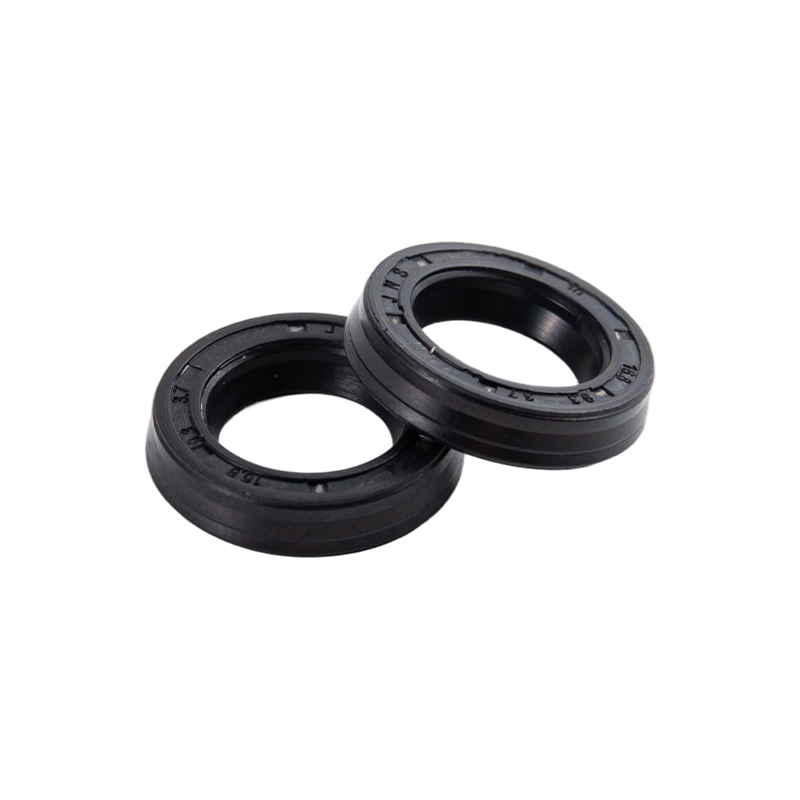
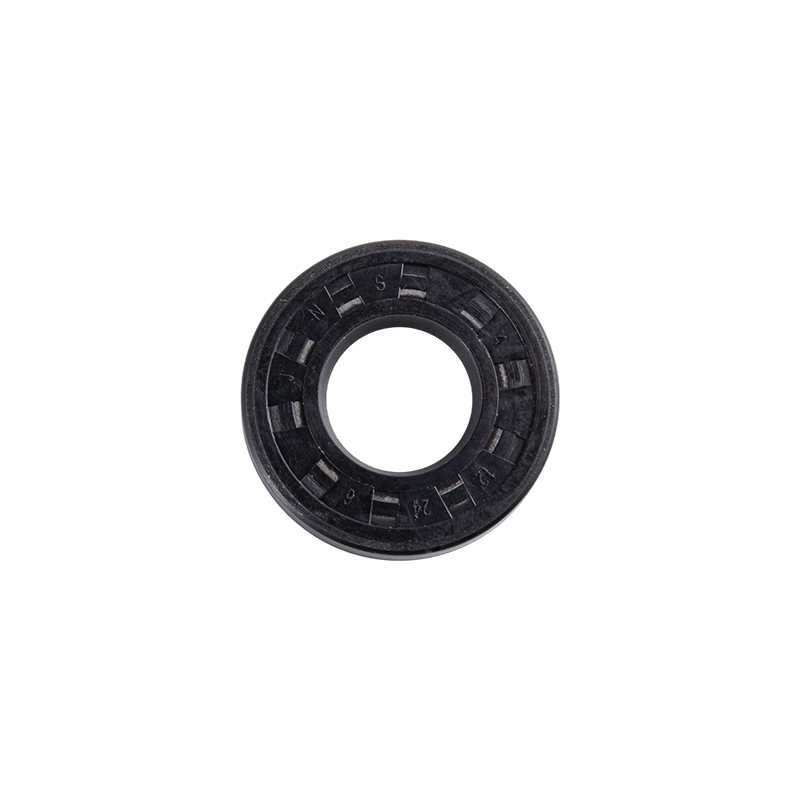
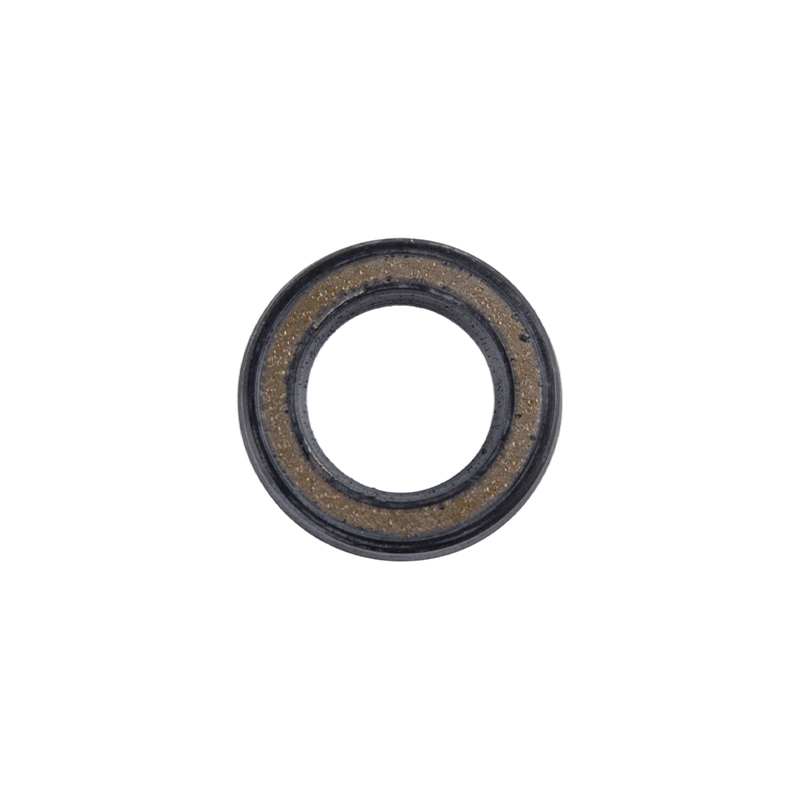
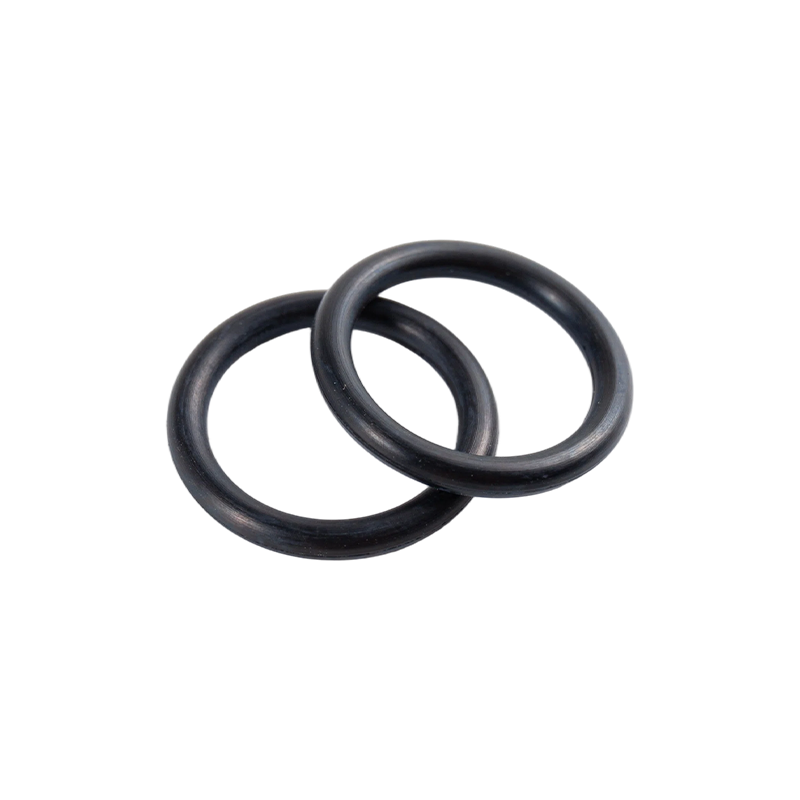
The Industrial Standard L-Ring Kinetic Seal, product code A-2-002, is designed for general industrial automation and reciprocating rod applications. Its L-shaped profile, NBR construction, and controlled dimensional design provide a practical solution for applications requiring stable sealing around an 8 mm piston rod installed in a 16 mm steel pipe. With an outside diameter of 16.45 mm, an inside diameter of 7.2 mm, and a height of 6 mm, the seal is engineered for a compact installation space while maintaining functional sealing contact.
This product is intended to balance dynamic loads within a design applicable range of 60N to 700N. Its profile is optimized to help prevent lip rollover, improve recovery after pressure changes, and support reliable reciprocating sealing. The seal is also designed with enhanced dry-run capability, which may help reduce downtime in operating conditions where lubrication is limited or temporarily interrupted.
As part of a broader sealing product portfolio, this L-ring can be used where a conventional O-ring, basic gasket, or less specialized lip seal may not provide sufficient performance during repeated rod movement. Its geometry is directed toward kinetic sealing, making it suitable for equipment designers and maintenance teams seeking a compact, repeatable, and production-ready sealing element.
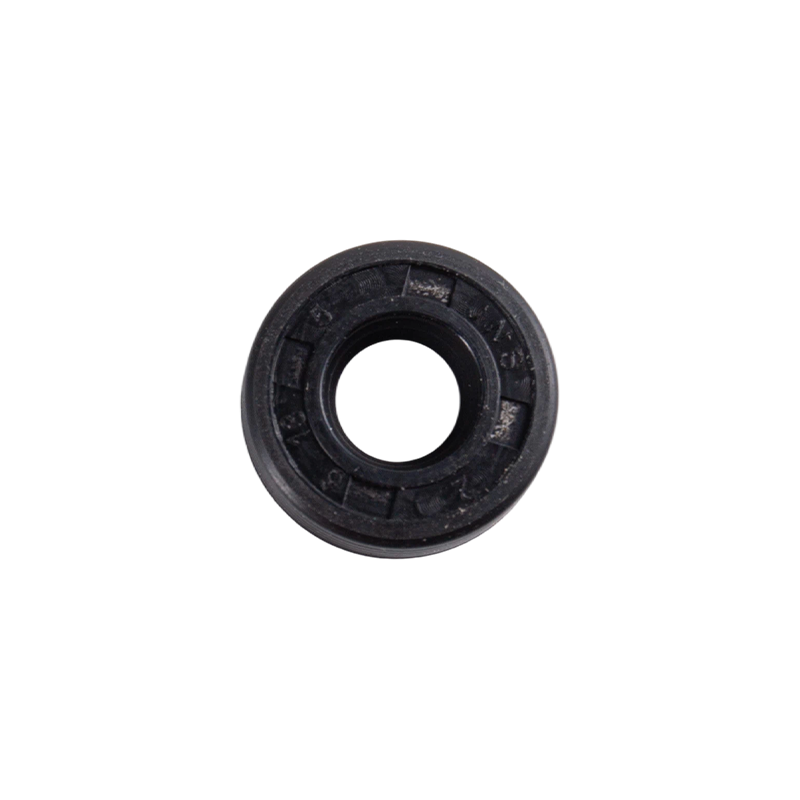
Industrial Standard L-Ring Kinetic Seal
Product Overview and Application Purpose
The A-2-002 L-ring is a specialized sealing component for reciprocating assemblies. Unlike a purely static gasket, it must maintain a controlled sealing interface while the piston rod moves in and out. This movement creates a combination of radial contact, sliding friction, pressure variation, and possible misalignment. The seal must therefore recover its shape, retain contact with the rod, and limit the passage of fluid or gas without generating unnecessary resistance.
The product is identified as an L-shaped oil seal ring and is also described as an industrial standard L-ring kinetic seal. The L-shaped cross-section gives the seal a supporting body and a working lip arranged for dynamic contact. This profile can provide a more purposeful sealing interface than a simple ring compressed uniformly in a groove. When correctly installed, the working edge can respond to motion and pressure while the body remains supported inside the assembly.
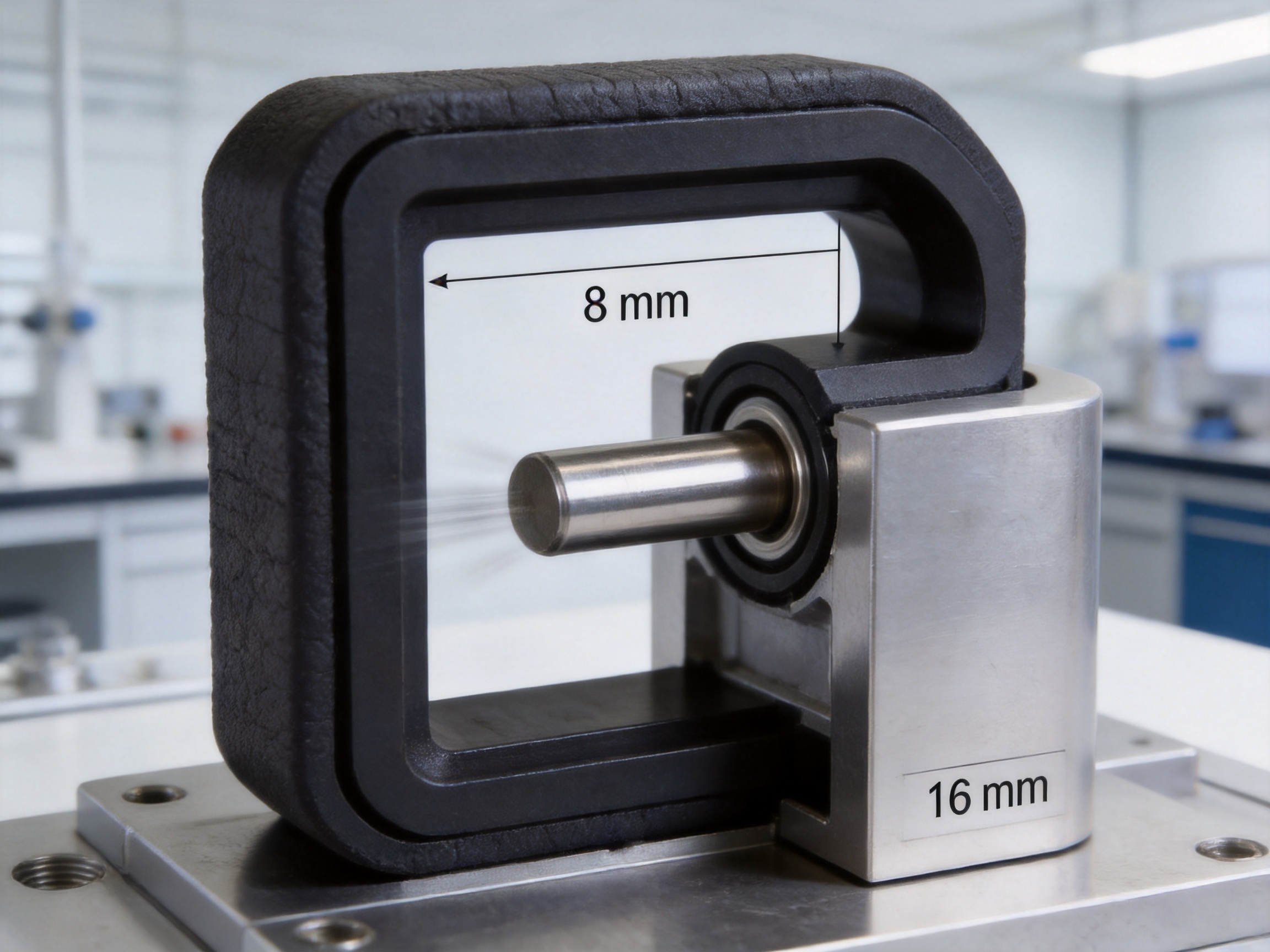
The specified application uses an 8 mm piston rod and a steel pipe with a 16 mm inner diameter. The listed product specification is 8*16*6, corresponding generally to the rod-related dimension, housing-related dimension, and seal height. The product table also identifies an outside diameter of 16.45 mm and an inside diameter of 7.2 mm. These dimensions should be checked against the actual groove, pipe, rod, tolerance, surface finish, and assembly method before production use.
The seal is particularly relevant to automation equipment because automated mechanisms often complete thousands or millions of movement cycles. In such systems, a minor leakage issue can become a major maintenance concern. A seal that loses contact, rolls over, or wears rapidly may cause pressure loss, lubricant contamination, unplanned stops, or replacement of an otherwise functional actuator. A profile designed specifically for reciprocating service can help address these risks at the component-selection stage.
The A-2-002 is also associated with 168 rod assemblies in its stated application description. This indicates a product concept intended for repeatable use across a defined family of rod-based assemblies rather than a one-off custom part. For manufacturers, this type of standardization can simplify purchasing, inventory control, assembly instructions, and replacement planning.
Key Technical Specifications
The following specifications summarize the supplied product information. Actual suitability depends on the complete operating environment, including temperature, medium, speed, stroke length, pressure behavior, surface condition, and installation tolerances.
| Item | Specification | Engineering Significance |
|---|---|---|
| Product type | L-shaped oil seal ring | Designed for dynamic, reciprocating sealing |
| Product code | A-2-002 | Identifies the standard product configuration |
| Product specification | 8*16*6 | Relates to rod, housing, and height dimensions |
| Outside diameter | 16.45 mm | Supports installation in the specified housing environment |
| Inside diameter | 7.2 mm | Provides working contact around an approximately 8 mm rod |
| Height | 6 mm | Defines the axial installation space |
| O-ring adapter | 16*8 | Indicates the related adapter dimension for the assembly |
| Steel pipe inner diameter and piston rod diameter | 16*8 | Defines the listed pipe-and-rod application format |
| Design applicable pressure range | 60N-700N | Indicates the supplied dynamic load range |
| Material | NBR | Provides a widely used elastomeric sealing material |
| Application focus | Industrial automation and reciprocating rod assemblies | Supports repeated linear movement |
The term “pressure range” in the supplied specification is expressed in newtons, which is a unit of force. For engineering approval, users should confirm whether this range represents axial load, sealing load, spring force, or another application-specific measurement. This clarification is important because operating pressure is normally expressed in pascals, bar, or megapascals, while a force range may describe the mechanical load applied to a rod assembly or seal system.
L-Shaped Profile for Dynamic Sealing
The central advantage of this product is its L-shaped configuration. Dynamic seals must do more than occupy space between two components. They must establish a controlled contact zone and remain stable during movement. An L-ring profile can provide a supporting base and a directional working lip, allowing the seal to respond to movement without relying only on uniform radial compression.
During installation, the seal body is positioned within the designated housing area while the inner sealing region contacts the piston rod. As the rod travels, the lip follows the rod surface. The profile must be flexible enough to maintain contact and sufficiently supported to resist excessive distortion. This balance is especially important when the assembly experiences changing loads or intermittent motion.
A poorly supported dynamic lip may roll, fold, twist, or move out of position. Lip rollover can create an immediate leakage path and may also accelerate wear. The A-2-002 is described as having an optimized profile that helps prevent lip rollover. In practical terms, the profile is intended to maintain a more stable orientation during reciprocating movement and load transitions.
The L-shaped structure also offers an alternative to using a basic O-ring for a motion-intensive application. O-rings are highly versatile and can perform effectively in many static and dynamic situations when groove design and operating conditions are appropriate. However, a dedicated kinetic seal may offer a more application-focused contact geometry for a particular rod assembly. The correct choice depends on the actual design, but a specialized profile can reduce the need to adapt a general-purpose ring to a demanding motion condition.
Another benefit of a defined profile is repeatability. When the cross-section is standardized, manufacturers can establish consistent installation procedures, inspection points, and replacement specifications. This can be valuable for equipment manufacturers producing multiple units with the same rod and housing arrangement.
Material Characteristics of NBR
The A-2-002 is manufactured from NBR, or nitrile rubber. NBR is widely used in sealing applications because it offers a practical combination of oil resistance, mechanical strength, abrasion resistance, and cost efficiency. These characteristics make it a common material for industrial oil seals, hydraulic components, pneumatic components, dampers, and general machinery.
For a reciprocating seal, abrasion resistance is important because the inner sealing region moves against the rod surface. Repeated sliding can gradually remove material, create surface roughness, or reduce the ability of the lip to maintain contact. NBR is frequently selected where a balanced level of wear resistance and flexibility is required.
NBR can also support applications involving many mineral-oil-based lubricants and hydraulic fluids, although compatibility must always be verified against the exact medium, formulation, temperature, concentration, and exposure time. Not every NBR compound has the same performance characteristics. Compound formulation, hardness, reinforcement, curing conditions, and post-processing can all influence the final result.
The use of NBR makes this seal a practical option for general industrial automation, particularly where operating conditions fall within the compound’s approved limits. It should not automatically be considered suitable for every chemical, fuel, refrigerant, solvent, food-processing medium, or high-temperature environment. If the application requires broader chemical resistance or elevated temperature performance, an alternative elastomer such as HNBR or FPM may be considered after technical evaluation.
Material selection should also account for low-temperature flexibility. A seal that becomes too stiff in a cold environment may require greater actuation force and may not follow the rod surface effectively. Conversely, excessive heat can accelerate aging, compression set, and wear. Therefore, NBR selection is most effective when combined with a clear understanding of the complete duty cycle.
Advantages in Comparison with Less Specialized Seals
The A-2-002 offers several potential advantages compared with generic sealing elements that are not specifically optimized for reciprocating service. The first is profile control. A dedicated L-ring can establish a purposeful dynamic interface rather than relying on an improvised arrangement of flat gaskets or standard rings.
The second advantage is stability under changing load. The product is designed for a stated applicable range of 60N to 700N, allowing it to be considered for applications where the sealing load is not constant. A seal that can recover after load changes may provide more consistent contact than a component that permanently deforms or loses its shape.
The third advantage is resistance to lip rollover. In a reciprocating assembly, the lip may experience drag in both directions. If its geometry is not adequately supported, the lip can turn over or move from its intended position. The specified profile is intended to reduce this risk, supporting longer operational stability and fewer leakage-related interruptions.
The fourth advantage is dry-run capability. Lubrication is beneficial for most sliding seals, but real machines may experience start-up periods, temporary lubricant loss, incorrect maintenance intervals, or short operating cycles that provide limited lubrication. Enhanced dry-run capability does not mean the seal should be operated indefinitely without lubrication. It means the design is intended to tolerate limited lubrication more effectively and help reduce the consequences of temporary dry conditions.
The fifth advantage is dimensional standardization. The defined 8*16*6 specification and the identified 16*8 adapter relationship provide a clear starting point for equipment designers. Standardized dimensions can reduce design uncertainty, simplify sourcing, and make replacement planning easier than using an unspecified or improvised sealing component.
Compared with a low-quality substitute, a controlled NBR L-ring may also offer better consistency from part to part. Dimensional variation, surface defects, incomplete curing, flash, contamination, and inconsistent hardness can all affect dynamic sealing. Manufacturing discipline is therefore as important as the nominal profile.
Manufacturing Quality and Process Strengths
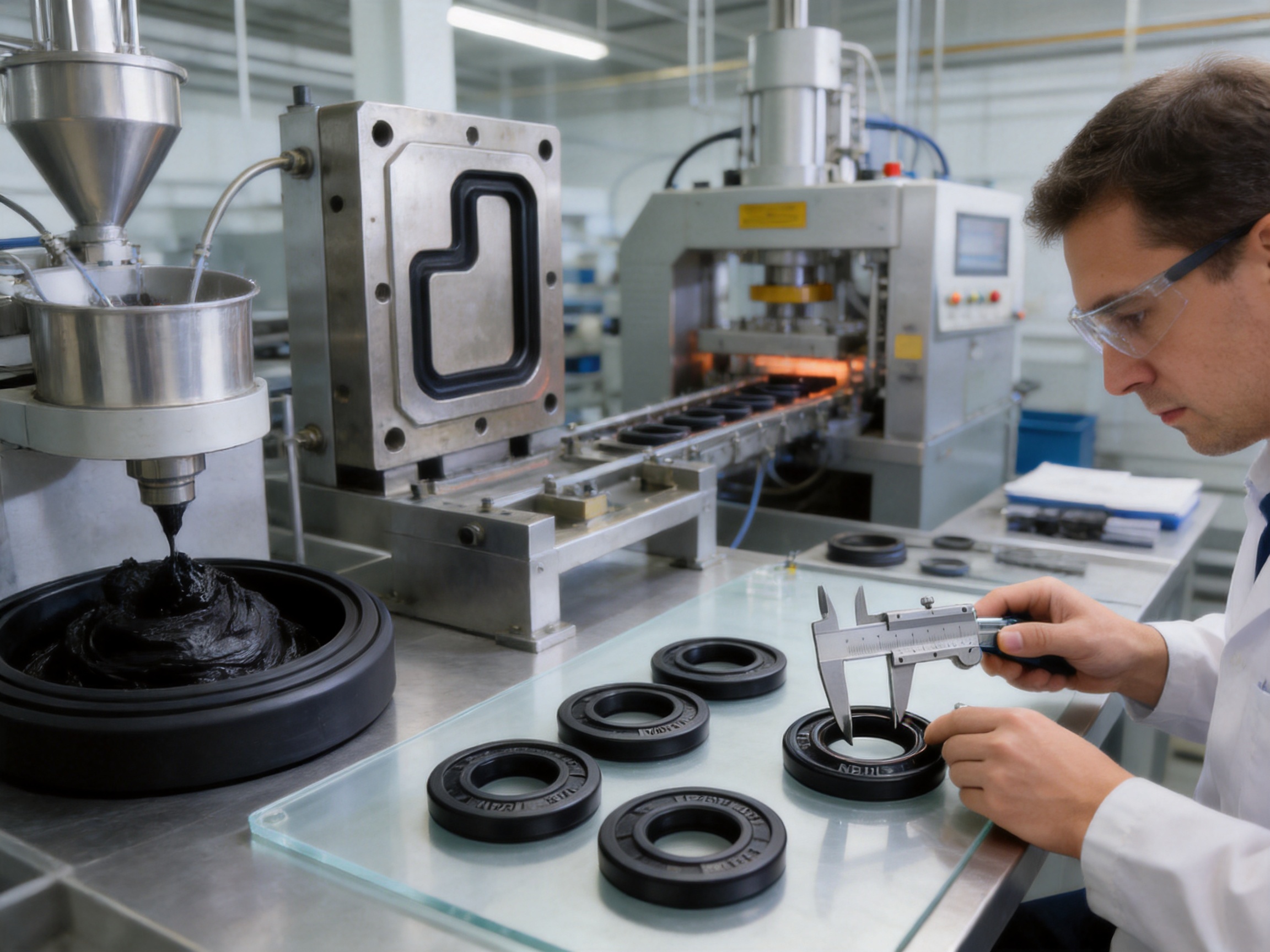
Sealing performance is created through the combination of design, material formulation, tooling, molding, inspection, and application support. A technically correct profile can still fail if the rubber compound is inconsistent or if the finished part contains defects. The manufacturer behind this product focuses on sealing technology for gas springs, dampers, and related O-ring products, providing a technical foundation relevant to dynamic rod sealing.
The company was founded in 2019 and operates as a high-tech enterprise in Anhui, China. Its stated focus includes the research, development, and application of sealing technology. This orientation is significant because dynamic seals require more than basic rubber processing. They must be evaluated as working components within a mechanical system.
A modern seal manufacturing process normally begins with material preparation. NBR raw materials and compound ingredients must be weighed and mixed according to a controlled formulation. Uniform mixing helps distribute polymers, fillers, plasticizers, curing agents, and other additives. Inconsistent mixing can produce variations in hardness, elasticity, compression behavior, and wear resistance.
After compounding, the material is typically prepared for molding in a form suitable for the selected production method. Tooling must reproduce the L-shaped profile accurately, including the working lip, supporting surfaces, transition zones, and dimensional features. Small errors in the lip geometry can affect contact pressure and friction. Tool maintenance is therefore important for controlling flash, edge definition, and repeatability.
Molding and vulcanization transform the prepared compound into an elastic seal. Temperature, pressure, time, and mold condition must be controlled to achieve the intended cure state. Under-curing can reduce strength and resilience, while over-curing can create excessive stiffness or brittleness. A stable process helps ensure that seals maintain their designed shape during repeated movement.
Post-molding operations may include trimming, removal of flash, cleaning, visual inspection, and dimensional checking. The working lip should be free from cuts, nicks, tears, excessive flash, or molding marks that could create leakage paths. The sealing surface should be handled carefully because damage may not always be visible after installation but can become significant during operation.
Quality control should address both material and geometry. Typical checks may include hardness measurement, dimensional inspection, appearance inspection, weight verification, and batch traceability. Depending on customer requirements, additional tests may evaluate compression set, tensile properties, elongation, aging, leakage, friction, or repeated movement. The exact inspection program should be confirmed for each product family and application.
The manufacturer’s stated strengths include strong research and development capabilities, advanced production equipment, and a professional technical service team. These capabilities support the development of standard products as well as customized sealing solutions. For an equipment manufacturer, access to technical consultation can be particularly valuable when the nominal dimensions do not fully explain the application.
Customization may include product design, testing, and technical consultation. A customized seal can be developed when a standard part must be adapted for a different rod diameter, housing size, stroke, pressure behavior, temperature range, or material requirement. The A-2-002 provides a standard starting point, while application-specific engineering can determine whether a modified design is more appropriate.
Design Considerations for Equipment Engineers
Correct installation is essential to obtaining the expected performance from any dynamic seal. Before specifying the A-2-002, engineers should confirm the rod diameter, housing diameter, groove geometry, available axial space, seal orientation, and installation path. The listed 16.45 mm outside diameter should not be treated as a substitute for a complete groove design review.
The piston rod surface must be suitable for sliding contact. Excessive roughness can act as an abrasive surface and wear the lip. A surface that is too smooth may not retain sufficient lubricant, depending on the application. Scratches, dents, corrosion, weld marks, and sharp edges can damage the seal during assembly or operation. Rod roundness and straightness should also be considered because radial runout can create uneven loading.
Housing condition is equally important. The bore should be clean, properly dimensioned, and free from burrs. A damaged housing may cut the seal or prevent the outside diameter from being supported uniformly. The installation groove should hold the seal securely without over-compressing the material.
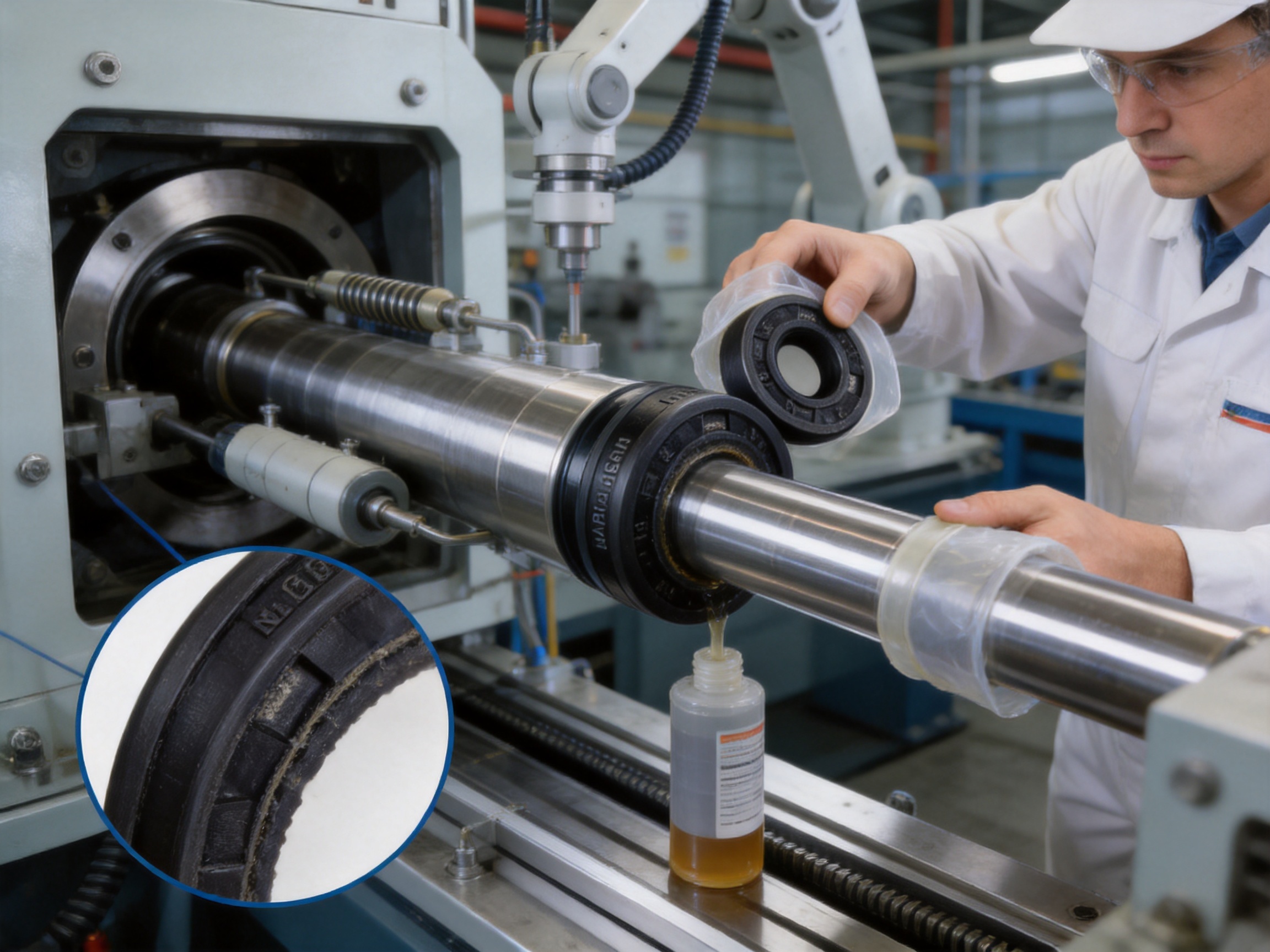
Assembly tools should be selected to protect the lip. If the seal must pass over a thread, keyway, hole, or sharp edge, a suitable protective sleeve or temporary guide may be required. Lubricating the seal and rod with a compatible medium can reduce installation friction, but the lubricant must be chemically compatible with NBR and the operating fluid.
Orientation should follow the assembly design and the direction of pressure or movement. A lip seal may have a preferred pressure-facing side. Reversing the component can reduce sealing effectiveness or increase the risk of lip displacement. Installation instructions should identify the correct orientation and any required adapter components.
Engineers should also review dynamic speed, stroke length, cycle frequency, and duty cycle. Two assemblies with the same rod diameter may create very different demands if one operates slowly for a few cycles per day while the other moves continuously at high speed. Heat generated by friction can accumulate in high-cycle applications and may influence material life.
The supplied design load range of 60N to 700N should be interpreted within the complete mechanical system. Users should confirm the meaning of the force specification with the manufacturer and avoid converting it directly into a fluid pressure rating without additional data. Where fluid or gas pressure is present, the housing support, extrusion gap, pressure direction, and backup arrangements must be reviewed separately.
Applications in Industrial Automation
Industrial automation equipment commonly uses linear actuators, pneumatic mechanisms, dampers, indexing units, clamping devices, and guided cylinders. These systems may operate in repetitive cycles and may need to maintain performance with minimal maintenance. An L-ring designed for reciprocating sealing can be used in compact rod assemblies where space is limited and controlled motion is required.
In automated production lines, seal failure can affect cycle time and product quality. A leaking actuator may move more slowly, lose force, or fail to reach its intended position. A contaminated assembly may also transfer oil or particles to nearby components. By supporting a more stable sealing interface, the A-2-002 can contribute to the reliability of the rod assembly.
Furniture mechanisms and gas spring systems are another relevant field. Adjustable chairs, lifting mechanisms, cabinets, and controlled-opening systems often use compact gas springs or dampers. These systems may experience repeated extension and compression, changing loads, and periods of storage followed by immediate use. A seal must remain resilient while maintaining contact after inactivity.
Automotive-related equipment may also use sealing components in dampers, actuators, and adjustment mechanisms. Such applications require careful validation because temperatures, vibration, fluids, and safety requirements can vary significantly. The A-2-002 may be considered for suitable auxiliary or general industrial applications, but automotive approval should be based on the specific system requirements and validation program.
Home appliances and medical equipment may use linear movement components where clean operation, compact dimensions, and predictable service are important. In these fields, fluid compatibility, cleanliness, regulatory requirements, and product traceability must be assessed in addition to ordinary mechanical performance. The manufacturer’s technical consultation capability can assist in evaluating whether NBR is appropriate or whether another material and process are necessary.
Construction equipment and industrial machinery can impose higher loads, greater contamination exposure, and harsher environmental conditions. A standard L-ring may be suitable for selected protected assemblies, but designers should assess dust, water, temperature, pressure spikes, and shock loading. Protective structures, wipers, filtration, and correct lubrication can significantly influence seal life.
Dry-Run Performance and Maintenance Value
Dry running is one of the most challenging conditions for a sliding elastomer seal. Without adequate lubrication, friction increases and heat can build at the contact edge. This can lead to accelerated wear, hardening, material transfer, or surface damage. The A-2-002 is described as having enhanced dry-run capability, which is a useful feature for applications where short periods of limited lubrication may occur.
Enhanced dry-run capability should be understood as improved tolerance, not permission to ignore lubrication requirements. The most reliable installation still uses a compatible lubricant or operating medium when the equipment design calls for one. The seal should not be intentionally subjected to prolonged dry operation unless the complete design has been tested for that condition.
Maintenance teams can improve seal life by inspecting the rod surface, checking for leakage, monitoring actuation force, and verifying that the assembly is not exposed to excessive side loading. Early signs of deterioration may include increased friction, visible oil film, pressure loss, unusual noise, slow movement, or inconsistent end positioning.
Replacing a seal before catastrophic failure can protect adjacent components and reduce downtime. Because the A-2-002 has a defined product code and dimensional specification, maintenance departments can establish a clear replacement standard. It is advisable to store replacement seals in a clean, cool, dry environment away from direct sunlight, ozone-generating equipment, sharp objects, and incompatible chemicals.
Seals should remain in their original protective packaging until use whenever possible. Excessive bending, stretching, folding, or compression during storage can permanently alter the profile. Before assembly, each part should be checked for visible defects, contamination, and dimensional conformity.
Why Manufacturing Partnership Matters
Purchasing a dynamic seal solely by nominal size can create avoidable risk. The same nominal dimensions may be produced with different materials, lip geometries, tolerances, and quality levels. A manufacturer with sealing-focused research and development can provide more useful technical input than a general component reseller, particularly when the application involves repeated motion or changing load.
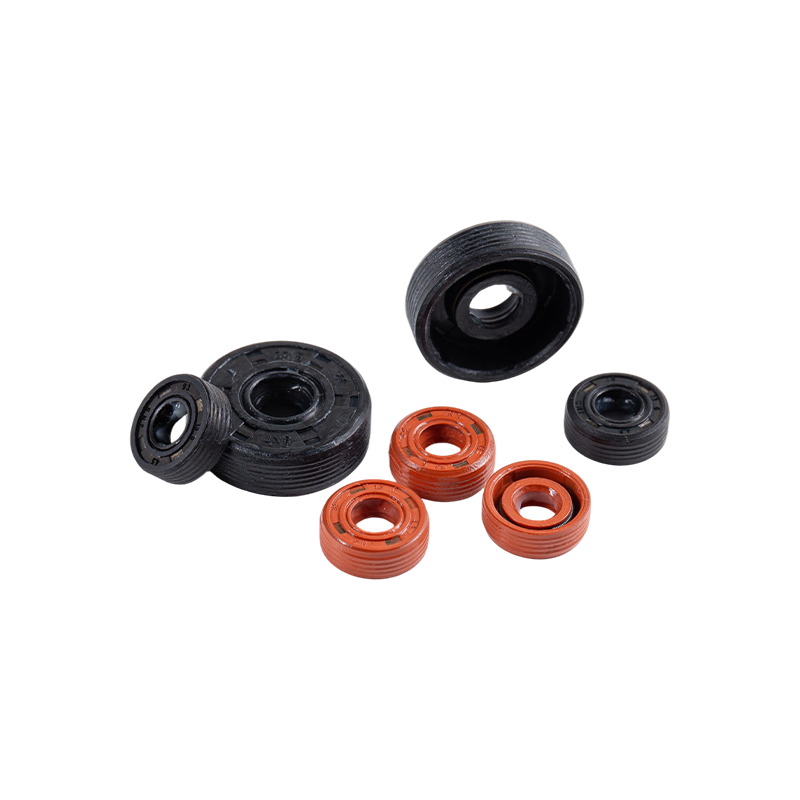
The manufacturer’s product range includes Y-type oil seal rings, L-shaped oil seal rings, damping oil seals, O-shaped oil seal rings, and other sealing items. This broader portfolio can support system-level selection. If an application changes from a reciprocating rod design to a static connection, a high-temperature assembly, or a different housing arrangement, related seal profiles may be available for comparison.
Technical support is also valuable during prototype development. Engineers may need to compare several materials, test different lip geometries, or evaluate leakage after a defined number of cycles. A supplier able to support product design and testing can help convert application requirements into a more suitable sealing specification.
For original equipment manufacturers, consistent production and traceable product coding simplify qualification. The A-2-002 code provides a reference for purchasing and service documentation. When combined with batch records and agreed inspection standards, product identification can contribute to more organized quality management.
The company serves industries including automotive, furniture, home appliances, medical equipment, construction, and other sectors. This range reflects experience with different mechanical environments and customer expectations. Although each application still requires separate validation, exposure to multiple industries can strengthen practical understanding of sealing challenges.
Installation and Validation Recommendations
Before installing the seal, confirm that the rod diameter and housing dimensions correspond to the intended design. The listed application uses an approximately 8 mm piston rod and a 16 mm steel pipe inner diameter. The product’s actual inside and outside dimensions are 7.2 mm and 16.45 mm respectively, so the assembly should be reviewed for interference, compression, and retention.
Clean all mating surfaces and remove metal chips, dust, oil residues, and old seal fragments. Inspect the rod for scratches and confirm that the entry edge is chamfered or otherwise protected. If the rod includes a thread or groove that the seal must cross, use a suitable installation sleeve.
Apply a thin layer of compatible lubricant where appropriate. Avoid tools with sharp edges and do not hammer directly on the seal. Press the component evenly into position, ensuring that it is not twisted or partially seated. A rolled or folded lip may fail immediately even if the outer dimensions appear correct.
After assembly, move the rod slowly through its initial stroke and check for unusual resistance. Verify that the seal remains in its intended position and that no leakage is present. Initial testing should be conducted under controlled conditions before the equipment is released for full-speed operation.
Validation testing may include static leakage, low-speed reciprocation, full-speed cycling, load variation, temperature exposure, lubricant compatibility, and dry-run intervals. The test program should represent the actual duty cycle as closely as possible. If the equipment is expected to operate at the upper end of the 60N to 700N design range, load transition tests should be included.
For qualification, record the number of cycles, stroke length, rod speed, temperature, medium, pressure or mechanical load, and seal condition after testing. This information can help distinguish a material issue from a rod-finish issue, installation problem, or excessive system load.
Performance Benefits for Production Users
For production users, the most important benefit of a reliable dynamic seal is often reduced interruption. A seal that maintains contact and resists rollover can help reduce leakage-related maintenance and extend the service interval of the assembly. Fewer unplanned replacements can improve equipment availability and reduce labor costs.
The compact dimensions of the A-2-002 allow it to serve applications where installation space is limited. A 6 mm height can be advantageous in assemblies designed around short axial envelopes, provided that the housing supplies adequate support. Compact size also helps equipment designers maintain a smaller actuator or damper package.
NBR provides an economically practical material choice for many general industrial applications. When the operating medium and temperature are compatible, it can deliver a useful balance between performance and cost. This can be important for equipment manufactured in medium or high volumes, where even a small difference in component cost may affect total production expense.
Profile standardization supports manufacturing consistency. Assembly personnel can work from a repeatable component specification instead of selecting among visually similar but functionally different rings. Purchasing teams can maintain a defined replacement part, while quality teams can establish incoming inspection criteria.
The seal’s stated recovery capability under a 700N peak load is another relevant feature for dynamic applications. Recovery helps the sealing element return toward its intended geometry after temporary deformation. This can support contact stability when the load varies, although actual recovery depends on compound properties, temperature, time under load, and assembly conditions.
Limits and Responsible Product Selection
No seal is universally suitable. The A-2-002 should be selected only after reviewing the complete operating environment. NBR may not be the preferred material for concentrated acids, strong solvents, aggressive chemicals, certain fuels, high-temperature service, or applications requiring specialized low-temperature flexibility.
Users should not assume that the listed 60N to 700N range is equivalent to a fluid-pressure rating. The unit and application meaning should be confirmed. If the assembly contains pressurized gas or liquid, the actual pressure rating must be established through design analysis and testing.
Excessive rod misalignment can cause one-sided lip loading and premature wear. Side loads should be supported by bearings or guides rather than transferred to the seal. Similarly, a seal should not be used to compensate for an incorrectly sized rod, damaged bore, poor surface finish, or excessive clearance.
Temperature limits should be verified for the exact NBR compound. Continuous heat, rapid temperature cycling, and exposure to hot fluid can change hardness and elasticity. Storage conditions also matter because ozone, ultraviolet exposure, and long-term deformation can age elastomeric products before installation.
Where the application is safety-critical, the seal should be qualified as part of the complete assembly. Component-level inspection is valuable, but it cannot replace system testing. The final result depends on the interaction of the seal, rod, housing, lubricant, pressure, load, speed, and environmental conditions.
Frequently Asked Questions
What type of product is the A-2-002?
The A-2-002 is an L-shaped oil seal ring, also described as an industrial standard L-ring kinetic seal. It is designed for reciprocating rod assemblies rather than only static sealing applications.
What are the main dimensions?
The supplied information lists a product specification of 8*16*6, an outside diameter of 16.45 mm, an inside diameter of 7.2 mm, and a height of 6 mm. The related O-ring adapter dimension is listed as 16*8.
What rod and housing arrangement is specified?
The listed application uses a steel pipe with a 16 mm inner diameter and a piston rod with an 8 mm diameter. The actual assembly should be checked against the complete groove and tolerance design.
What material is used?
The product is made from NBR, or nitrile rubber. NBR is widely used for oil seals because of its practical balance of oil resistance, abrasion resistance, resilience, and cost efficiency.
Is the product suitable for reciprocating motion?
Yes. The product is specifically described as a kinetic seal for reciprocating rod assemblies. Its profile is intended to maintain contact during repeated movement and to reduce the risk of lip rollover.
What does the 60N-700N range mean?
The supplied data calls this the design applicable pressure range, but the unit is newtons, which measures force. Users should confirm the exact meaning with the manufacturer before comparing it with a fluid-pressure rating.
Can the seal operate without lubrication?
The seal is described as having enhanced dry-run capability, meaning it is intended to tolerate limited lubrication more effectively. It should not be considered suitable for unlimited dry operation unless the complete assembly has been tested and approved for that condition.
How does the L-shaped profile compare with a basic O-ring?
An O-ring can perform well in many applications, but an L-shaped kinetic seal provides a profile specifically arranged for dynamic rod contact. The L-ring may offer more purposeful lip support and improved resistance to rollover in a suitable reciprocating assembly.
What industries can use this product?
Potential fields include industrial automation, gas springs, dampers, furniture mechanisms, home appliances, automotive-related equipment, medical equipment, construction machinery, and other rod-based systems. Each application requires separate material and performance validation.
How should the seal be installed?
Clean the rod and housing, remove burrs, protect the lip from threads or sharp edges, use compatible lubrication where appropriate, and press the seal evenly into position. The seal should not be twisted, folded, or damaged during assembly.
What information should be provided when requesting technical support?
Useful information includes rod diameter, housing diameter, groove dimensions, stroke, speed, cycle frequency, temperature, medium, lubrication, load, pressure, surface finish, and expected service life. Providing these details helps determine whether the standard product is appropriate or whether a customized design is needed.
Can customized sealing solutions be developed?
The manufacturer provides customized sealing solutions that may include product design, testing, and technical consultation. Customization can be considered when the standard A-2-002 dimensions or NBR material do not fully match the application.
Conclusion
The Industrial Standard L-Ring Kinetic Seal, A-2-002, is a compact NBR sealing component designed for reciprocating rod assemblies. Its 16.45 mm outside diameter, 7.2 mm inside diameter, 6 mm height, and 8*16*6 specification provide a defined foundation for industrial automation and related equipment designs.
Its principal performance advantages include an L-shaped dynamic profile, support against lip rollover, recovery under changing loads, and enhanced tolerance of limited dry-running conditions. These features make it a more application-focused option than a generic sealing element when the equipment requires repeated rod movement.
The product is supported by a manufacturer whose stated capabilities include sealing research and development, advanced production equipment, technical service, product design, testing, and customized solutions. These strengths are important because seal reliability depends on controlled materials, accurate tooling, stable molding, careful inspection, and application-specific engineering.
For best results, users should verify dimensions, clarify the meaning of the stated load range, confirm NBR compatibility, inspect rod and housing conditions, and validate the complete assembly under realistic operating conditions. When properly matched to the application, the A-2-002 can contribute to reliable motion, reduced leakage risk, simplified maintenance, and improved equipment availability.
References
1. Manufacturer-supplied product specification for Industrial Standard L-Ring Kinetic Seal, Product Code A-2-002.
2. Manufacturer-supplied technical information on NBR sealing products and L-shaped oil seal rings.
3. General engineering principles for elastomeric seals used in reciprocating rod assemblies.
4. General guidance on rubber compound selection, dynamic sealing, installation, and maintenance.
5. General industrial practices for dimensional inspection, molding quality control, and seal validation testing.
Product: Industrial Standard L-Ring Kinetic Seal

PREV:26 mm Large-Aperture Adapter Seal for High-Performance Gas Springs and Dampers
NEXT:High-Performance HNBR Dual-Function Seal for Damping and Inflation Systems
NEXT:High-Performance HNBR Dual-Function Seal for Damping and Inflation Systems


Want to know more
about us?
about us?

Precision sealing for gas springs and dampers. Durable, wear-resistant, and built for long-life performance in demanding applications.
Product Categories
Quick Links
Contact Us
-
Email: jns@jnsseals.cn

-
Email: LouZhuoyu@outlook.com
-
Manager Gong: +86-18563770820

-
Manager Wang: +8615357558902
-
No. 5, Meilin Avenue, Meilin Industrial Development Zone, Ningguo City, Anhui Province, China

