

 English
 русский
 Deutsch
 Türk
 中文简体
13.3mm Precision-Fit NBR O-Ring for Reliable Non-Standard Sealing Applications
13.3mm Precision-Fit NBR O-Ring for Reliable Non-Standard Sealing Applications
13.3mm Precision-Fit NBR O-Ring for Reliable Non-Standard Sealing Applications
13.3mm Precision-Fit NBR O-Ring for Reliable Non-Standard Sealing Applications
13.3mm Precision-Fit NBR O-Ring for Reliable Non-Standard Sealing Applications
13.3mm Precision-Fit NBR O-Ring for Reliable Non-Standard Sealing Applications
13.3mm Precision-Fit NBR O-Ring for Reliable Non-Standard Sealing Applications
13.3mm Precision-Fit NBR O-Ring for Reliable Non-Standard Sealing Applications
13.3mm Precision-Fit NBR O-Ring for Reliable Non-Standard Sealing Applications
13.3mm Precision-Fit NBR O-Ring for Reliable Non-Standard Sealing Applications
13.3mm Precision-Fit NBR O-Ring for Reliable Non-Standard Sealing Applications
13.3mm Precision-Fit NBR O-Ring for Reliable Non-Standard Sealing Applications
13.3mm Precision-Fit NBR O-Ring for Reliable Non-Standard Sealing Applications
13.3mm Precision-Fit NBR O-Ring for Reliable Non-Standard Sealing Applications
13.3mm Precision-Fit NBR O-Ring for Reliable Non-Standard Sealing Applications
13.3mm Precision-Fit NBR O-Ring for Reliable Non-Standard Sealing Applications

Fang Zhiqing — International Product Sales Manager
Home / Author / Fang Zhiqing — International Product Sales Manager / 13.3mm Precision-Fit NBR O-Ring for Reliable Non-Standard Sealing Applications
NEW Category
Contact us
13.3mm Precision-Fit NBR O-Ring for Reliable Non-Standard Sealing Applications
Content
- 1 Product Overview
- 2 Why a Precision-Fit Dimension Matters
- 3 Material Characteristics of NBR
- 4 Key Advantages Compared with General-Purpose Alternatives
- 5 Engineering Principles Behind O-Ring Sealing
- 6 Manufacturing and Quality-Oriented Strengths
- 7 Application Areas
- 8 Installation Recommendations
- 9 Storage and Handling
- 10 Selection and Validation Process
- 11 How the Product Supports Manufacturing Efficiency
- 12 Customization and Technical Cooperation
- 13 Quality and Supplier Evaluation
- 14 Frequently Asked Questions
- 14.1 What is the exact size of the A-4-008 O-ring?
- 14.2 What material is used for this product?
- 14.3 What does the product code mean?
- 14.4 Is the A-4-008 suitable for every oil sealing application?
- 14.5 Can it be used in a dynamic application?
- 14.6 What is the benefit of the 13.3mm inside diameter?
- 14.7 Why is the 1.65mm cross-section important?
- 14.8 Can the product accommodate slight eccentricity?
- 14.9 How should the O-ring be installed?
- 14.10 Can the company provide customized O-rings?
- 14.11 Are HNBR and FPM alternatives available?
- 14.12 What industries can use this type of product?
- 15 Conclusion
- 16 References
- 17 Product: 13.3mm Precision-Fit O-Ring
In sealing systems, the difference between a dependable assembly and a recurring maintenance problem can be measured in fractions of a millimeter. A groove that does not match a standard nominal size, a component with slight eccentricity, or an application that requires a carefully controlled assembly load may all create challenges for conventional sealing products. The 13.3mm Precision-Fit O-Ring, product code A-4-008, is designed for this type of requirement. With a 13.3mm inside diameter and a 1.65mm cross-sectional width, it provides a practical sealing solution for non-standard fittings and compact mechanical assemblies.
Manufactured from NBR, the A-4-008 combines elastic recovery, dimensional precision, and broad industrial usefulness. Its geometry is particularly suitable for applications that cannot be served efficiently by common nominal O-ring sizes. Rather than forcing a standard seal into an unsuitable groove, engineers can select a seal that more closely corresponds to the actual dimensions of the equipment. This approach may improve installation consistency, reduce unnecessary deformation, and support reliable performance during service.
The product is supplied by Ningguo Jnsseals Sealing Technology Co., Ltd., a high-tech sealing enterprise founded in 2019 and based in Anhui, China. The company focuses on sealing technology for gas springs, dampers, and related O-ring products. Its capabilities include product research and development, sealing solution design, testing, manufacturing, and technical consultation. These strengths allow the A-4-008 to be positioned not simply as an individual rubber ring, but as part of a broader engineering-oriented sealing program.
Product Overview
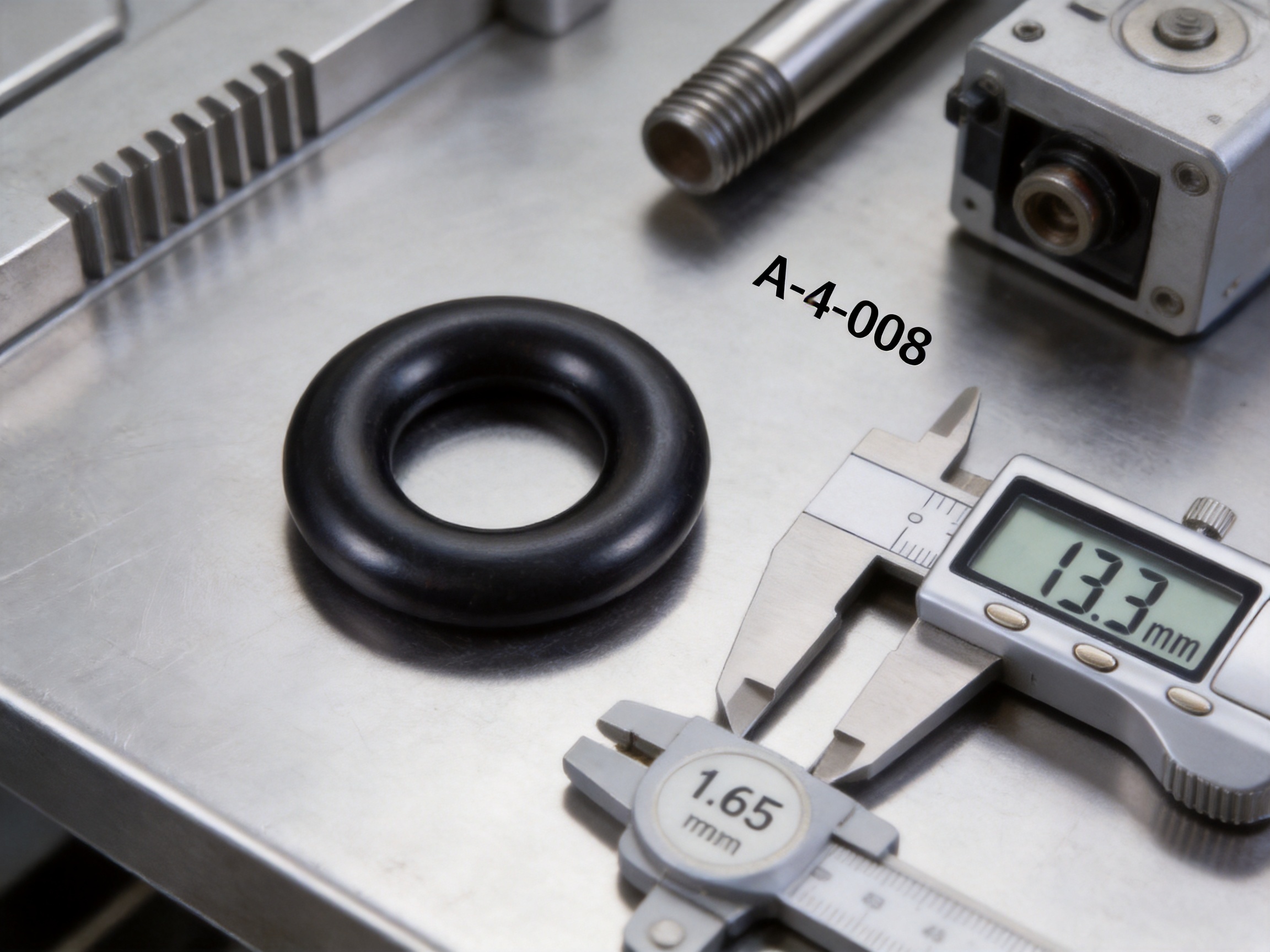
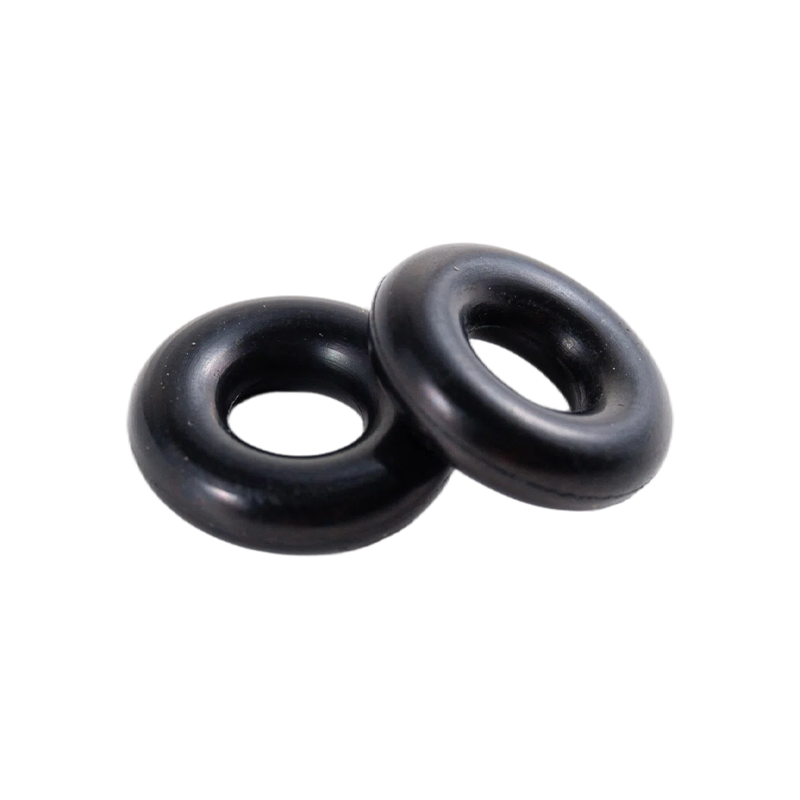
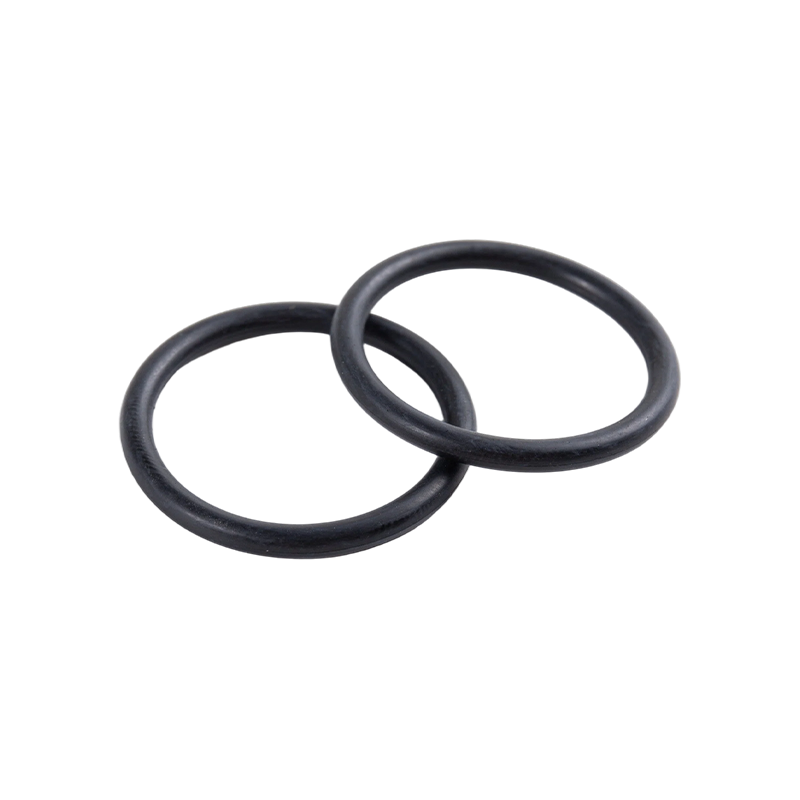
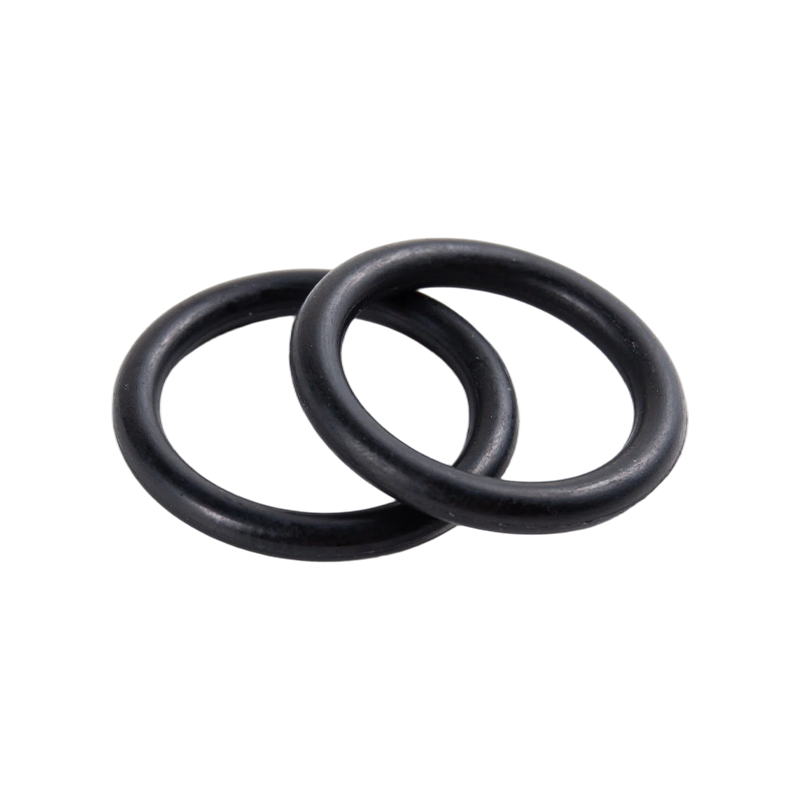
The A-4-008 is an O-shaped oil seal ring with a precise 13.3mm inside diameter and a 1.65mm cross-sectional width. These dimensions create a compact circular sealing profile that can be used in static and selected dynamic sealing arrangements, subject to appropriate groove design, pressure, temperature, lubrication, and motion conditions.
| Product Item | Specification |
| Product Name | 13.3mm Precision-Fit O-Ring |
| Product Code | A-4-008 |
| Product Category | O-Shaped Oil Seal Ring |
| Inside Diameter | 13.3mm |
| Cross-Sectional Width | 1.65mm |
| Material | NBR |
| Primary Design Purpose | Precision sealing for non-standard fittings and compact assemblies |
| Recommended Evaluation Factors | Groove dimensions, pressure, temperature, medium compatibility, and movement |
The product description identifies the 13.3mm inside diameter as a key feature for solving sealing challenges associated with non-standard fittings. The 1.65mm cross-sectional width is intended to provide a moderate assembly load. This balance can be valuable where an overly large seal would require excessive insertion force, while an undersized seal might not provide sufficient contact or compression.
Although the ring is compact, its performance depends on the complete sealing system. The O-ring must be matched with an appropriate groove, mating surface, compression ratio, surface finish, pressure condition, and operating medium. When these factors are correctly controlled, the circular profile can create a continuous line of contact that helps prevent the passage of liquids, oils, gases, and other media.
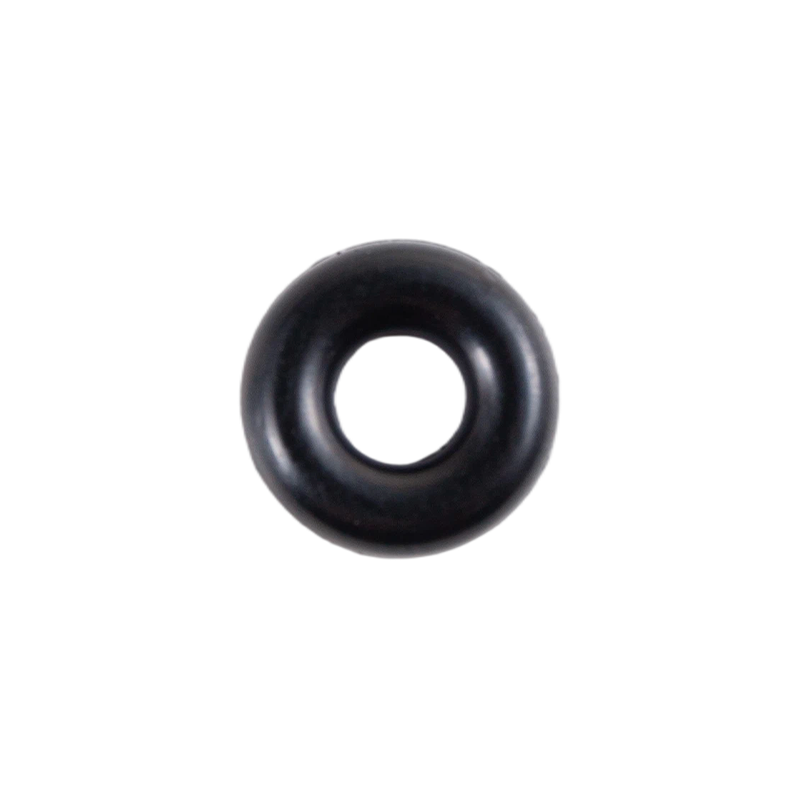
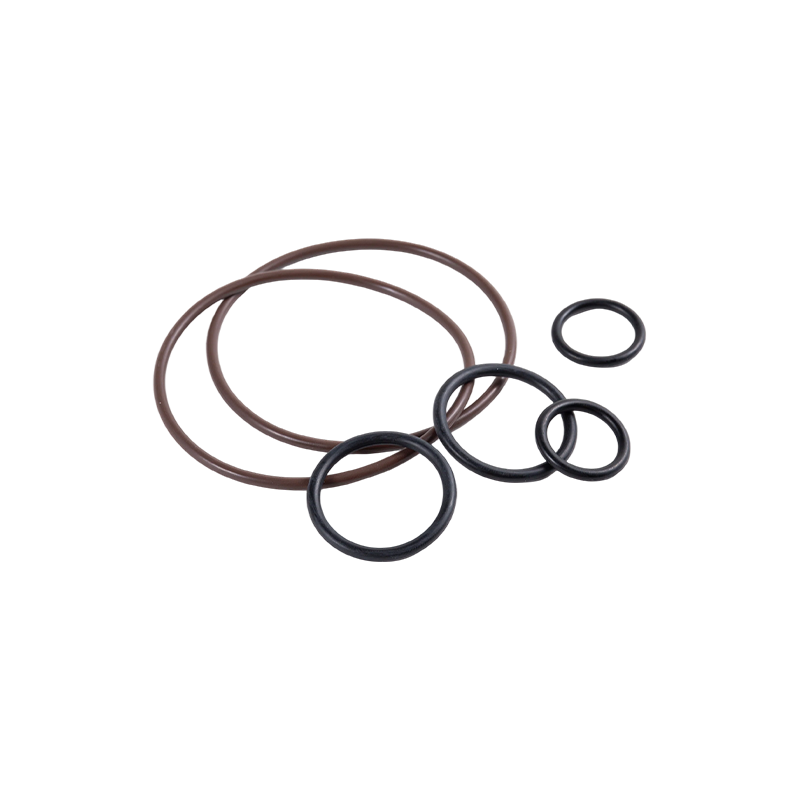
13.3mm Precision-Fit O-Ring
Why a Precision-Fit Dimension Matters
Many sealing problems begin with the assumption that every application can use a commonly stocked standard size. Standardization is useful, but mechanical components are not always designed around the most familiar dimensions. Equipment may be produced according to a proprietary design, a legacy drawing, a regional standard, or a special compact layout. In such cases, a slightly different inside diameter or cross-sectional width can affect sealing reliability.
The 13.3mm ID of the A-4-008 is useful when a 13mm, 13.5mm, or another nearby nominal size does not provide the desired fit. A difference of only a few tenths of a millimeter can influence how the seal sits on a shaft, inside a bore, or within a groove. If the seal is too loose, it may fail to remain correctly positioned during assembly or operation. If it is too tight, it may be overstretched, twisted, damaged, or difficult to install.
Precision-fit sizing also supports more consistent engineering decisions. Designers can select a ring based on measured or specified component dimensions instead of relying on trial and error. This is especially important in compact assemblies, where access is limited and repeated disassembly can increase labor costs or damage adjacent components.
The 1.65mm cross-sectional width provides another useful dimensional option. Cross-section influences the amount of compression available, the groove size, the required assembly force, and the seal’s ability to accommodate surface irregularities. A moderate width can be suitable for assemblies that require a compact seal without the heavier compression and larger installation envelope associated with a thicker ring.
Material Characteristics of NBR
The A-4-008 is manufactured from NBR, commonly known as nitrile rubber. NBR is widely used in industrial sealing because it offers a practical balance of oil resistance, elasticity, abrasion resistance, and cost efficiency. It is frequently selected for applications involving mineral oils, lubricating oils, greases, hydraulic fluids, and other compatible petroleum-based media.
NBR is also valued for its ability to maintain useful sealing contact across a broad range of ordinary industrial applications. Its elastic properties enable the ring to recover after moderate deformation, helping it maintain contact with the mating surfaces. This recovery is important because sealing interfaces may experience small dimensional changes caused by assembly variation, vibration, pressure fluctuation, or thermal movement.
Material selection must always be based on the actual service environment. NBR is not universally compatible with every chemical, fuel, solvent, refrigerant, or high-temperature fluid. For applications involving aggressive chemicals, elevated temperatures, specialized fuels, or unusual gases, users should request a compatibility assessment and consider alternative elastomers such as HNBR or FPM when appropriate.
The company’s product portfolio includes NBR, HNBR, and FPM O-ring products. This broader material capability is valuable for customers whose equipment includes more than one operating environment. A supplier that can discuss material alternatives may help customers avoid selecting a seal solely by size while overlooking the effects of the working medium and temperature.
Key Advantages Compared with General-Purpose Alternatives
Closer dimensional matching
The primary advantage of the A-4-008 is its precise 13.3mm inside diameter. General-purpose alternatives may be available only in nearby standard sizes, forcing users to accept a compromise. A closer dimensional match can simplify assembly and reduce the risk of excessive stretch, insufficient positioning, or an unsuitable compression relationship.
Moderate assembly load
With a 1.65mm cross-sectional width, the ring is intended to provide moderate assembly loading when used in a correctly designed groove. This can be beneficial for manual assembly, automated insertion, and compact components where excessive force may deform the housing or complicate production.
Compact sealing profile
The relatively small cross-section allows the A-4-008 to fit into assemblies where space is limited. Compact seals may help equipment designers reduce groove size, preserve surrounding material, or package multiple components within a smaller housing. A compact profile can also be practical in instruments, dampers, furniture hardware, appliance components, and other products where space and appearance matter.
Reliable contact under slight eccentricity
The product description highlights reliable performance even in slight eccentric conditions. In real assemblies, perfect concentricity is not always achievable. Small variations may result from machining tolerance, component alignment, installation, or operating movement. An elastomeric ring can accommodate limited irregularity by maintaining resilient contact, provided that the eccentricity remains within the design capability of the seal and does not cause excessive wear or extrusion.
Broad industrial usefulness
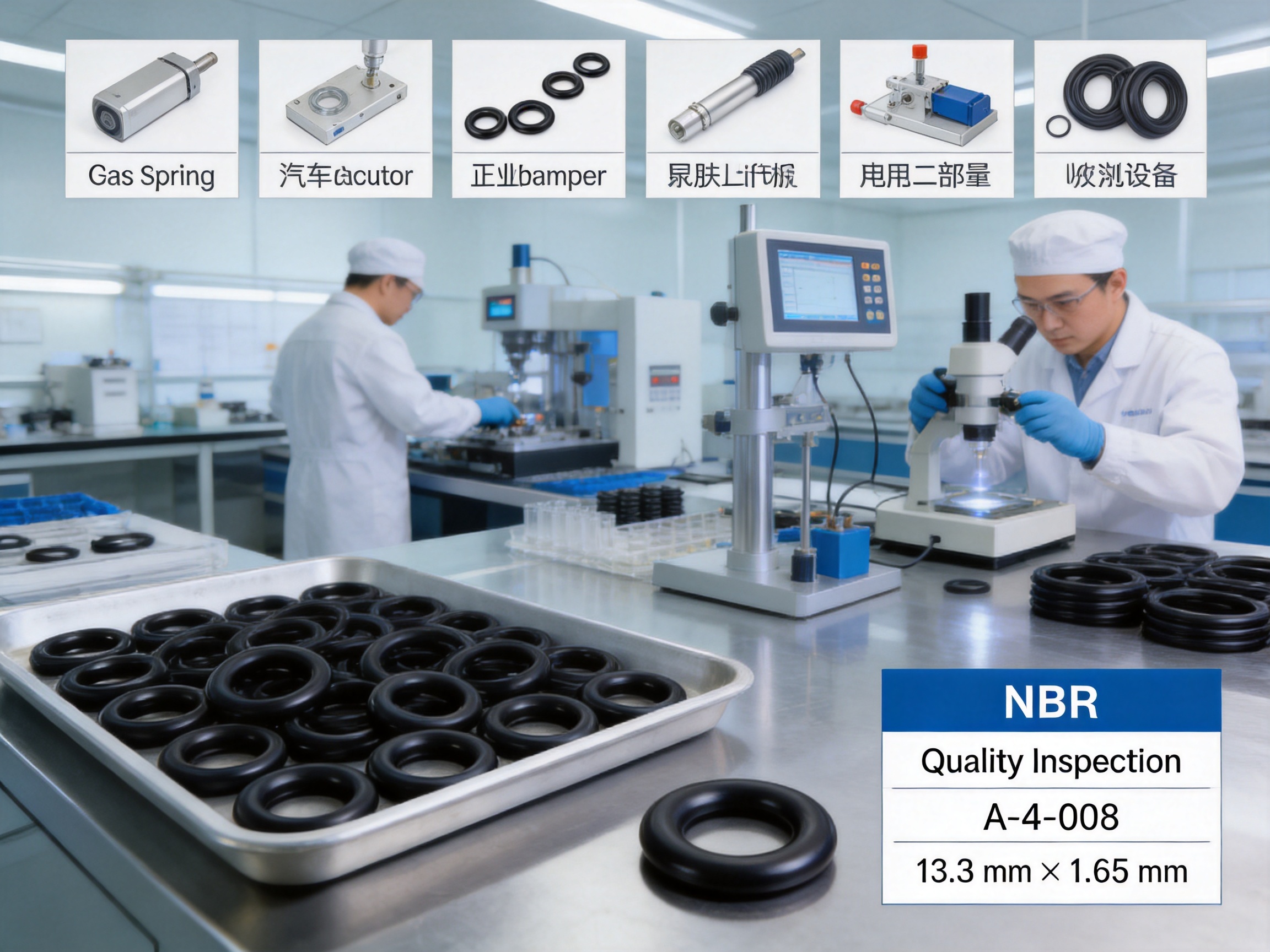
NBR O-rings are used in numerous industries because they provide a practical solution for many oil and fluid sealing requirements. The A-4-008 can be evaluated for applications in automotive components, gas springs, dampers, furniture mechanisms, home appliances, construction equipment, medical equipment, and general industrial assemblies. The correct use depends on the specific pressure, temperature, medium, and motion conditions.
Reduced dependence on improvised substitutions
When the required dimension is unavailable, maintenance teams sometimes substitute a nearby size, add sealant, or reuse an old ring. Such methods may provide a temporary result but can create inconsistent quality and uncertain service life. A dedicated precision-fit product gives purchasing and maintenance teams a clearer replacement option and supports more repeatable assembly procedures.
Engineering Principles Behind O-Ring Sealing
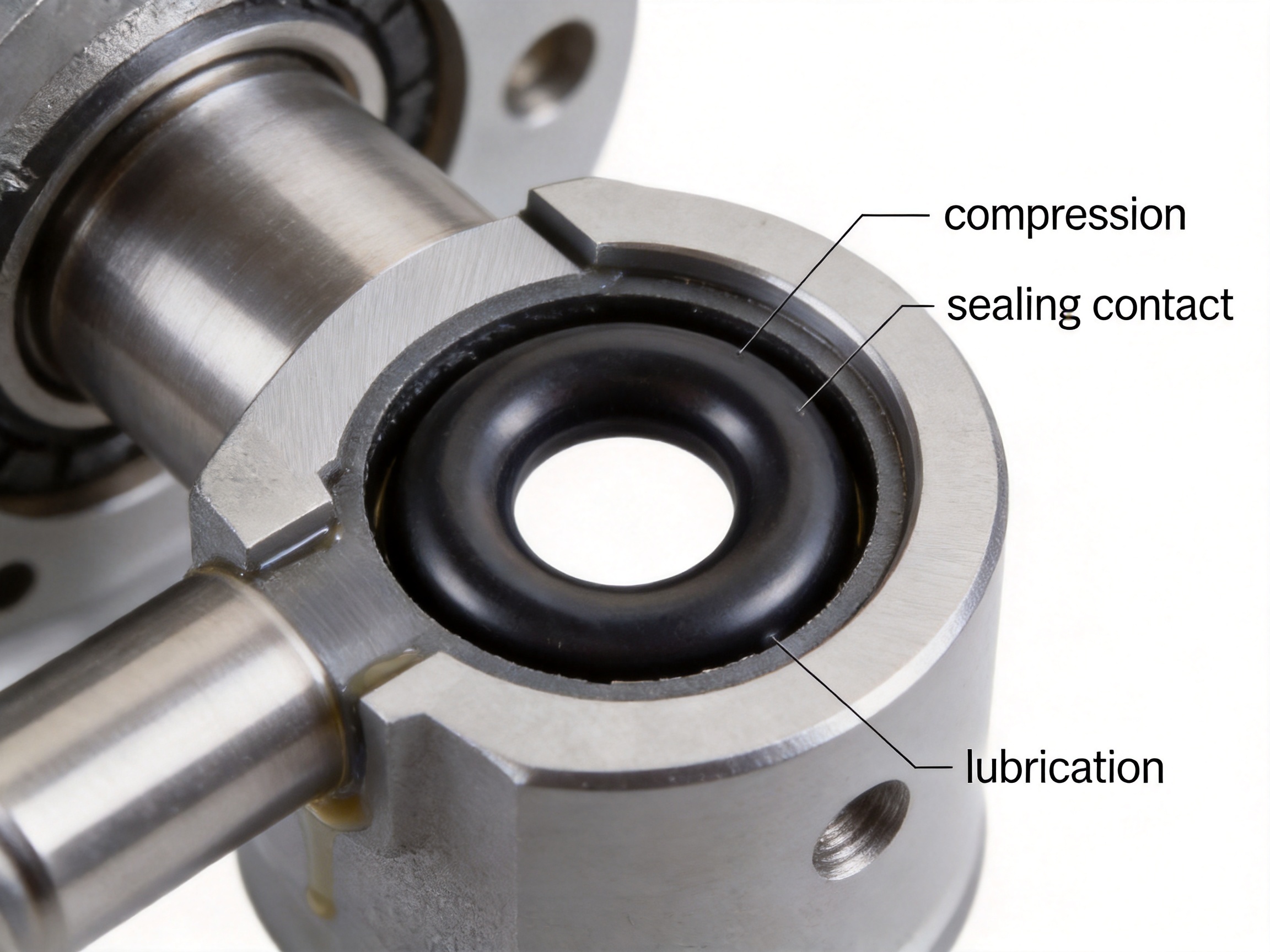
An O-ring seals by creating controlled interference between its circular cross-section and the surfaces around it. In a static radial application, the ring may be installed in a groove around a shaft or inside a housing. In a static axial application, it may be compressed between two flat surfaces. When pressure is introduced, the elastomer can be pushed toward the lower-pressure side of the sealing gap, increasing contact force and supporting the sealing effect.
The amount of initial squeeze is a central design factor. Too little squeeze may allow leakage, especially when surfaces are imperfect or when pressure fluctuates. Too much squeeze may increase friction, accelerate wear, complicate assembly, and permanently damage the elastomer. The A-4-008’s dimensions should therefore be considered together with the mating groove and hardware tolerances.
Stretch is also important. An O-ring installed over a shaft normally experiences some increase in inside diameter. Excessive stretch can reduce the cross-sectional diameter and alter the final compression. It may also make the ring more difficult to install and increase the risk of tearing. A precision-fit 13.3mm ID helps designers and assemblers work from a more controlled starting dimension.
Clearance must be managed carefully when pressure is present. If the gap between mating components is too large, the elastomer may extrude into the clearance space. Pressure, temperature, material hardness, groove geometry, and dynamic movement all influence extrusion risk. For demanding applications, the user should confirm the design with appropriate engineering calculations and testing.
Surface finish is another essential factor. A surface that is excessively rough may abrade the ring or create leakage paths. A surface that is too smooth may not retain sufficient lubricant in some dynamic applications. Edges should be properly chamfered and free from burrs so that the ring is not cut during installation. These principles apply to the A-4-008 as they do to other precision elastomeric seals.
Manufacturing and Quality-Oriented Strengths
Ningguo Jnsseals Sealing Technology Co., Ltd. describes itself as a high-tech enterprise focused on the research, development, and application of sealing technology. Its business is centered on gas spring and damper seals, O-ring products, and related sealing solutions. This specialization gives the company an application-oriented foundation for producing compact elastomeric components such as the A-4-008.
Manufacturing a reliable O-ring requires more than forming rubber into a circular shape. The material must be prepared consistently, the compound must be suitable for the intended service, and the molding process must produce a stable profile. Dimensional control is important because deviations in inside diameter or cross-sectional width can affect assembly and compression. Surface quality is equally important because flash, voids, cuts, or molding imperfections may create potential leakage paths.
The company reports strong research and development capabilities, advanced production equipment, and a professional technical service team. Together, these resources support a process that can address product development from multiple directions. Research and development can help evaluate dimensions and materials. Production equipment supports repeatable manufacturing. Technical service helps customers match the product to their equipment and operating conditions.
A professional sealing manufacturer should view quality as a process rather than a final inspection step. Incoming raw materials, compound preparation, mold condition, molding parameters, trimming, visual inspection, dimensional inspection, packaging, and traceability all contribute to the finished result. Attention at each stage helps reduce variation between batches and supports stable customer production.
For a precision-fit product, manufacturing consistency is particularly important. If the nominal dimensions are correct but batch-to-batch variation is uncontrolled, the customer may experience changes in assembly force or sealing behavior. Stable production practices help ensure that the 13.3mm ID and 1.65mm WD remain meaningful specifications rather than approximate descriptions.
Product development capability
The company provides customized sealing solutions, including product design, testing, and technical consultation. This capability is useful when the A-4-008 is close to the required size but the customer needs a different material, hardness, tolerance, color, or packaging arrangement. A supplier with development support can participate earlier in the design process and help identify potential issues before mass production.
Application experience
Experience with gas springs, dampers, automotive products, furniture mechanisms, appliances, medical equipment, and construction-related applications exposes a manufacturer to a variety of sealing conditions. These applications may involve repeated motion, vibration, pressure changes, compact installation areas, and demanding expectations for service consistency.
Technical communication
Technical service is particularly valuable for non-standard fittings. Customers may provide a drawing, a sample, a measurement, or a description of the operating environment. The supplier can then help clarify whether the 13.3mm ID and 1.65mm width are suitable, whether NBR is appropriate, and whether additional testing is advisable.
Application Areas
Gas springs and dampers
Gas springs and dampers often use compact seals to retain pressure and control the movement of a rod or piston. The A-4-008 may be evaluated in assemblies where a small, accurately sized ring is required. The final design must account for rod diameter, pressure, reciprocating motion, lubrication, temperature, and wear. NBR can be a practical option when the fluid and operating range are compatible.
Automotive components
Automotive systems frequently contain small fluid, oil, and air sealing interfaces. A precision-fit O-ring may be useful in connectors, actuators, dampers, valves, and other assemblies with specialized dimensions. Automotive applications can involve vibration, temperature cycling, and exposure to oils or additives, so compound selection and validation are essential.
Furniture hardware
Adjustable furniture, lifting mechanisms, office equipment, and motion-control hardware may use gas springs or compact dampers. In these products, smooth assembly and dependable sealing can influence product feel, service life, and customer satisfaction. The A-4-008’s moderate assembly load and compact geometry may support efficient manufacturing where installation space is limited.
Home appliances
Appliances may require seals for pumps, valves, actuators, fluid connections, or moving mechanisms. The appropriate seal depends on the fluid, temperature, cleaning agents, and expected operating cycles. NBR may be suitable for selected oil or compatible fluid applications, while other materials may be preferred for high-temperature or chemically aggressive environments.
Medical equipment
Medical equipment requires careful evaluation of material compatibility, cleanliness, regulatory expectations, and service conditions. The A-4-008 can be considered for suitable non-sterile or compatible mechanical sealing applications, but users must independently verify all material, biocompatibility, cleanliness, and regulatory requirements before use in medical devices.
Construction and industrial equipment
Construction equipment and general machinery often contain hydraulic, pneumatic, and lubricated components. Compact O-rings can be used in control systems, fittings, valves, and actuators. Because pressure and environmental exposure may be severe, designers should evaluate extrusion, abrasion, temperature, and fluid compatibility rather than selecting a seal based on size alone.
Installation Recommendations
Correct installation is essential to obtaining the expected performance from the A-4-008. Before assembly, inspect the ring for cuts, cracks, flattened areas, contamination, or other visible defects. The groove and mating components should be clean and free from metal chips, dust, sharp edges, and old seal fragments.
Verify the groove dimensions against the approved drawing or design standard. The groove should provide the intended squeeze without over-compressing the ring. The inside diameter should be checked against the shaft or bore dimension, and the assembly path should be evaluated for possible stretching or twisting.
Use a compatible lubricant when permitted by the application. Lubrication can reduce insertion force and lower the risk of abrasion or cutting during installation. The lubricant must not attack NBR or contaminate the working medium. In applications where lubrication is prohibited, the installation process should be designed to minimize friction and mechanical damage.
Do not roll, twist, or stretch the O-ring unnecessarily. A twisted ring may develop a spiral leak path or experience concentrated stress during operation. When the ring is installed over a threaded section, keyway, port, or sharp transition, use a suitable protective sleeve or cover the damaging feature during insertion.
After installation, confirm that the ring is fully seated. It should not be pinched, displaced, or protruding from the groove. If the assembly uses moving components, rotate or move them slowly during initial inspection to confirm that the seal remains correctly positioned.
Storage and Handling
Elastomeric seals should be stored in a clean, cool, and dry environment away from direct sunlight and sources of ozone. Excessive heat, ultraviolet exposure, humidity, and atmospheric contaminants can affect long-term material condition. Rings should remain in their original packaging until they are needed for assembly whenever practical.
Avoid hanging O-rings on nails, hooks, or sharp fixtures. Long-term stretching can permanently deform the material. Heavy objects should not be placed on packages, and seals should not be stored in a way that creates sharp folds or compression marks.
Stock rotation is recommended. Older inventory should generally be used before newer inventory, subject to the company’s storage-life policy and the condition of the product. Before installation, inspect any ring that has been stored for an extended period. If there is uncertainty about its condition or storage history, technical review or replacement is advisable.
Selection and Validation Process
The first step in selecting the A-4-008 is to identify the application type. Determine whether the seal will be static or dynamic, radial or axial, and exposed to internal or external pressure. Dynamic applications require additional consideration of speed, stroke, friction, lubrication, and wear.
The second step is to confirm dimensional compatibility. Measure the shaft, bore, groove width, groove depth, and clearance. Compare these dimensions with the design requirements for a 13.3mm ID and 1.65mm cross-section. Do not rely solely on an old seal because it may have experienced swelling, compression set, wear, or permanent deformation.
The third step is to evaluate the medium. Identify the fluid, gas, oil, grease, cleaning agent, or chemical that will contact the ring. Check the expected concentration, pressure, and temperature. NBR is widely used with many petroleum-based oils and greases, but compatibility should be confirmed for special fluids and additives.
The fourth step is to assess the operating environment. Consider temperature cycling, vibration, shock, dirt, moisture, ultraviolet exposure, ozone, and installation frequency. An application that is mild during normal operation may still be demanding during startup, shutdown, cleaning, or emergency conditions.
The final step is validation. Prototype testing, pressure testing, leak testing, endurance cycling, and environmental testing may be appropriate depending on the application. A supplier’s technical team can help identify which tests are most relevant. For high-consequence applications, production approval should be based on documented test results rather than dimensional selection alone.
How the Product Supports Manufacturing Efficiency
In production environments, seal selection affects more than leakage prevention. It can influence assembly time, operator fatigue, tooling requirements, rework, and inspection procedures. A ring with a closer dimensional match may be easier to place and less likely to pop out of a groove during component assembly.
The moderate assembly load associated with the 1.65mm width may be helpful for manual and semi-automated processes. Lower insertion resistance can reduce the need for excessive force, although the actual force depends on squeeze, lubrication, surface condition, and component tolerances. Production engineers should confirm the assembly behavior under real line conditions.
Consistent supply is also important. A manufacturer that offers product design, testing, technical consultation, and related material options can support customers through development and production changes. This may reduce the disruption associated with changing suppliers when a new material or modified dimension is required.
For international buyers, clear product identification is useful. The A-4-008 code, 13.3mm ID, 1.65mm WD, and NBR material provide a concise basis for purchasing records, engineering drawings, inspection plans, and replacement orders. Proper documentation helps prevent the accidental substitution of a similar-looking but dimensionally different ring.
Customization and Technical Cooperation
Not every sealing challenge can be solved with an existing catalog size. A customer may need a different inside diameter, cross-section, material, hardness, tolerance, or surface finish. Ningguo Jnsseals Sealing Technology Co., Ltd. provides customized sealing solutions and supports product design, testing, and technical consultation.
The most effective customization process begins with complete application information. Customers should provide component drawings or samples, groove dimensions, operating pressure, temperature range, medium, movement, expected service life, assembly method, and any applicable industry requirements. Photographs and failure samples can also help explain the problem.
Technical cooperation may involve reviewing the existing design, identifying the likely cause of leakage, proposing a different O-ring size, selecting a more suitable compound, or recommending a change to the groove. In some cases, the best solution is not a different seal but an adjustment to surface finish, chamfer design, clearance, or installation procedure.
Testing should be aligned with the actual application. A material test conducted under one fluid and temperature may not predict performance in another environment. Prototype testing under representative pressure, motion, and temperature conditions provides more useful information for final approval.
Quality and Supplier Evaluation
When purchasing precision O-rings, buyers should evaluate both the product and the manufacturer. Important questions include whether the supplier can maintain dimensional consistency, whether material information is available, whether inspection procedures are defined, and whether technical assistance is provided when application conditions change.
A capable supplier should be able to communicate product specifications clearly. For the A-4-008, the basic specification is 13.3mm by 1.65mm, with NBR listed as the product material. Customers may also request information about applicable tolerances, hardness, batch identification, inspection records, packaging, and storage recommendations.
Manufacturing resources are another consideration. The company’s stated investment in research and development, production equipment, and technical service indicates an integrated approach to sealing products. This can be particularly valuable for customers requiring both standard catalog items and customized products.
Supplier evaluation should also include responsiveness. A prompt technical response can help prevent an incorrect seal from entering production. For non-standard dimensions, the ability to discuss drawings, samples, and test requirements may be as important as the initial unit price.
Frequently Asked Questions
What is the exact size of the A-4-008 O-ring?
The A-4-008 has a 13.3mm inside diameter and a 1.65mm cross-sectional width. Its listed specification is 13.3 × 1.65mm.
What material is used for this product?
The product is made from NBR, or nitrile rubber. NBR is commonly used for oil, grease, and many compatible industrial fluid applications. Compatibility should be checked for the specific medium and operating temperature.
What does the product code mean?
A-4-008 is the product code assigned to this specific O-ring model. Using the code together with the dimensions and material helps purchasing and engineering teams identify the correct product.
Is the A-4-008 suitable for every oil sealing application?
No. The ring is designed for appropriate applications involving compatible conditions, but suitability depends on pressure, temperature, fluid, groove design, clearance, and motion. NBR should not be assumed to be compatible with every oil, chemical, fuel, or gas.
Can it be used in a dynamic application?
It may be considered for selected dynamic applications, but dynamic use requires additional evaluation of speed, stroke, lubrication, surface finish, friction, wear, and extrusion. The application should be tested before full production approval.
What is the benefit of the 13.3mm inside diameter?
The 13.3mm dimension provides a closer fit for certain non-standard shafts, bores, or grooves than nearby conventional sizes. This can help reduce the need for dimensional compromise and support more consistent installation.
Why is the 1.65mm cross-section important?
The cross-section affects compression, assembly force, groove dimensions, and sealing contact. The 1.65mm width offers a compact profile and is described as providing a moderate assembly load when used in a suitable design.
Can the product accommodate slight eccentricity?
The product description identifies reliable performance under slight eccentric conditions. However, the amount of eccentricity that can be tolerated depends on pressure, clearance, movement, surface condition, material behavior, and the complete assembly design.
How should the O-ring be installed?
Inspect the ring and groove, remove contamination and sharp edges, apply compatible lubrication when allowed, avoid twisting and cutting, and ensure that the ring is fully seated before closing the assembly. Installation should follow the approved engineering procedure.
Can the company provide customized O-rings?
Yes. Ningguo Jnsseals Sealing Technology Co., Ltd. provides customized sealing solutions, including product design, testing, and technical consultation. Customers should provide complete information about dimensions, material requirements, pressure, temperature, medium, and movement.
Are HNBR and FPM alternatives available?
The company’s product offering includes NBR, HNBR, and FPM O-ring products. Alternative materials may be considered when the application requires different temperature performance, chemical resistance, or mechanical properties.
What industries can use this type of product?
Potential industries include automotive, furniture, home appliances, medical equipment, construction, gas spring and damper manufacturing, and general industrial equipment. Actual suitability must be confirmed for each application.
Conclusion
The 13.3mm Precision-Fit O-Ring, A-4-008, addresses an important need in modern sealing design: the need for accurate, compact, and application-specific dimensions. Its 13.3mm inside diameter makes it a practical option for non-standard fittings, while its 1.65mm cross-section supports a compact installation profile and moderate assembly load. Manufactured from NBR, it offers the familiar advantages of nitrile rubber for many compatible oil, grease, and industrial fluid applications.
Compared with a nearby general-purpose size, a precision-fit ring can provide a more controlled relationship between the seal and the mating components. This may improve installation consistency, support reliable contact under slight eccentricity, and reduce reliance on improvised substitutions. Nevertheless, the product must be selected and installed as part of a complete sealing system. Groove design, compression, stretch, clearance, pressure, temperature, fluid compatibility, surface finish, and movement all influence final performance.
The strength of the product is supported by the capabilities of Ningguo Jnsseals Sealing Technology Co., Ltd. As a high-tech enterprise focused on sealing technology, the company combines product development, production resources, testing, and technical consultation. Its experience with gas springs, dampers, O-rings, and customized sealing solutions enables it to serve customers seeking both catalog products and application-specific designs.
For engineers, manufacturers, and maintenance teams, the A-4-008 provides a clear starting point for evaluating a non-standard sealing requirement. By combining precise dimensions, NBR material, technical support, and a manufacturing process focused on sealing applications, it can contribute to dependable performance in compact mechanical systems and a wide range of industrial products.
References
1. Ningguo Jnsseals Sealing Technology Co., Ltd. Product information for A-4-008, 13.3mm × 1.65mm NBR O-Ring.
2. Ningguo Jnsseals Sealing Technology Co., Ltd. Company information concerning sealing technology, product development, testing, and technical consultation.
3. General engineering guidance on elastomeric O-ring design, groove geometry, compression, stretch, clearance, and installation practice.
4. General material reference information concerning nitrile rubber, including oil resistance, elasticity, abrasion resistance, and application limitations.
5. General industrial sealing practice concerning storage, handling, inspection, compatibility evaluation, and prototype validation of rubber seals.
Product: 13.3mm Precision-Fit O-Ring

PREV:2000N Extreme Thrust Seal: High-Pressure NBR Sealing for Demanding Hydraulic Applications
NEXT:7×1.9 Standard Kinetic O-Ring for Low-Friction Reciprocating Sealing
NEXT:7×1.9 Standard Kinetic O-Ring for Low-Friction Reciprocating Sealing


Want to know more
about us?
about us?

Precision sealing for gas springs and dampers. Durable, wear-resistant, and built for long-life performance in demanding applications.
Product Categories
Quick Links
Contact Us
-
Email: jns@jnsseals.cn

-
Email: LouZhuoyu@outlook.com
-
Manager Gong: +86-18563770820

-
Manager Wang: +8615357558902
-
No. 5, Meilin Avenue, Meilin Industrial Development Zone, Ningguo City, Anhui Province, China

