

 English
 русский
 Deutsch
 Türk
 中文简体
7.3 mm Pneumatic-Grade O-Ring Seal: Design, Performance, and Manufacturing Advantages
7.3 mm Pneumatic-Grade O-Ring Seal: Design, Performance, and Manufacturing Advantages
7.3 mm Pneumatic-Grade O-Ring Seal: Design, Performance, and Manufacturing Advantages
7.3 mm Pneumatic-Grade O-Ring Seal: Design, Performance, and Manufacturing Advantages
7.3 mm Pneumatic-Grade O-Ring Seal: Design, Performance, and Manufacturing Advantages
7.3 mm Pneumatic-Grade O-Ring Seal: Design, Performance, and Manufacturing Advantages
7.3 mm Pneumatic-Grade O-Ring Seal: Design, Performance, and Manufacturing Advantages
7.3 mm Pneumatic-Grade O-Ring Seal: Design, Performance, and Manufacturing Advantages
7.3 mm Pneumatic-Grade O-Ring Seal: Design, Performance, and Manufacturing Advantages
7.3 mm Pneumatic-Grade O-Ring Seal: Design, Performance, and Manufacturing Advantages
7.3 mm Pneumatic-Grade O-Ring Seal: Design, Performance, and Manufacturing Advantages
7.3 mm Pneumatic-Grade O-Ring Seal: Design, Performance, and Manufacturing Advantages
7.3 mm Pneumatic-Grade O-Ring Seal: Design, Performance, and Manufacturing Advantages
7.3 mm Pneumatic-Grade O-Ring Seal: Design, Performance, and Manufacturing Advantages
7.3 mm Pneumatic-Grade O-Ring Seal: Design, Performance, and Manufacturing Advantages
7.3 mm Pneumatic-Grade O-Ring Seal: Design, Performance, and Manufacturing Advantages

Fang Zhiqing — International Product Sales Manager
Home / Author / Fang Zhiqing — International Product Sales Manager / 7.3 mm Pneumatic-Grade O-Ring Seal: Design, Performance, and Manufacturing Advantages
NEW Category
Contact us
7.3 mm Pneumatic-Grade O-Ring Seal: Design, Performance, and Manufacturing Advantages
Content
- 1 Product Overview
- 2 Why Pneumatic Applications Require Specialized Sealing
- 3 Material Performance of NBR
- 4 Key Product Advantages
- 5 Advantages Compared with Generic Competitor Seals
- 6 Manufacturing Process and Quality Control
- 7 Research and Development Strengths
- 8 Customization and Engineering Support
- 9 Application Areas
- 10 Installation Recommendations
- 11 Selection and Validation Checklist
- 12 Company Manufacturing and Service Capabilities
- 13 Quality, Supply, and Business Value
- 14 How to Compare Suppliers
- 15 Frequently Asked Questions
- 15.1 What is the A-4-004 seal?
- 15.2 What does the 7.3 mm dimension represent?
- 15.3 What does the 2.4 mm dimension represent?
- 15.4 Why is NBR used for this product?
- 15.5 Can this seal be used in every pneumatic actuator?
- 15.6 Is the A-4-004 suitable for dynamic sealing?
- 15.7 What makes a pneumatic-grade O-ring different from a generic O-ring?
- 15.8 Can the manufacturer provide customized sealing solutions?
- 15.9 What information should a buyer provide when requesting a quotation?
- 15.10 How should the seal be stored before use?
- 15.11 What should be done if leakage occurs after installation?
- 16 Conclusion
- 17 References
- 18 Product: 7.3mm Pneumatic-Grade Seal
Reliable sealing is one of the most important requirements in pneumatic actuators, gas springs, dampers, and other compact fluid-power assemblies. A seal that appears small and simple can determine whether an actuator maintains pressure, whether a damper performs consistently, and whether a finished product delivers the expected service life. For this reason, selecting the correct internal diameter, wire diameter, elastomer, compression level, and manufacturing quality is essential.
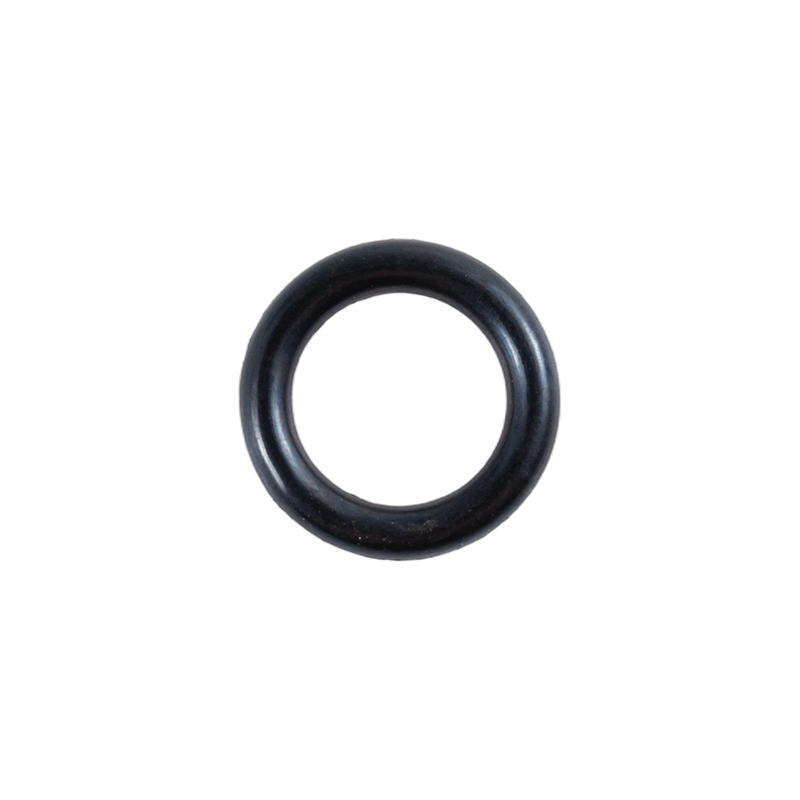
The 7.3 mm Pneumatic-Grade Seal, identified by product code A-4-004, is an O-shaped oil seal ring developed for pneumatic applications. It has an internal diameter of 7.3 mm and a wire diameter of 2.4 mm. The seal is manufactured from nitrile rubber, commonly known as NBR, and is designed to provide dependable airtightness, dimensional stability, and resistance to compression-related performance loss in suitable pneumatic operating environments.
Although the component is compact, its design addresses several challenges found in pneumatic sealing. Pneumatic assemblies depend on effective gas retention, accurate compression, low leakage, and stable operation over repeated cycles. Any weakness in material selection or dimensional consistency may result in pressure loss, reduced actuator force, inconsistent movement, or premature maintenance. The A-4-004 is therefore positioned as a specialized sealing solution rather than a generic ring selected only by nominal size.
This article examines the product’s dimensions, material, operating value, application advantages, quality considerations, and the manufacturing capabilities behind its production. It also explains how a specialized sealing manufacturer can support product development through design assistance, testing, technical consultation, and customized sealing solutions.
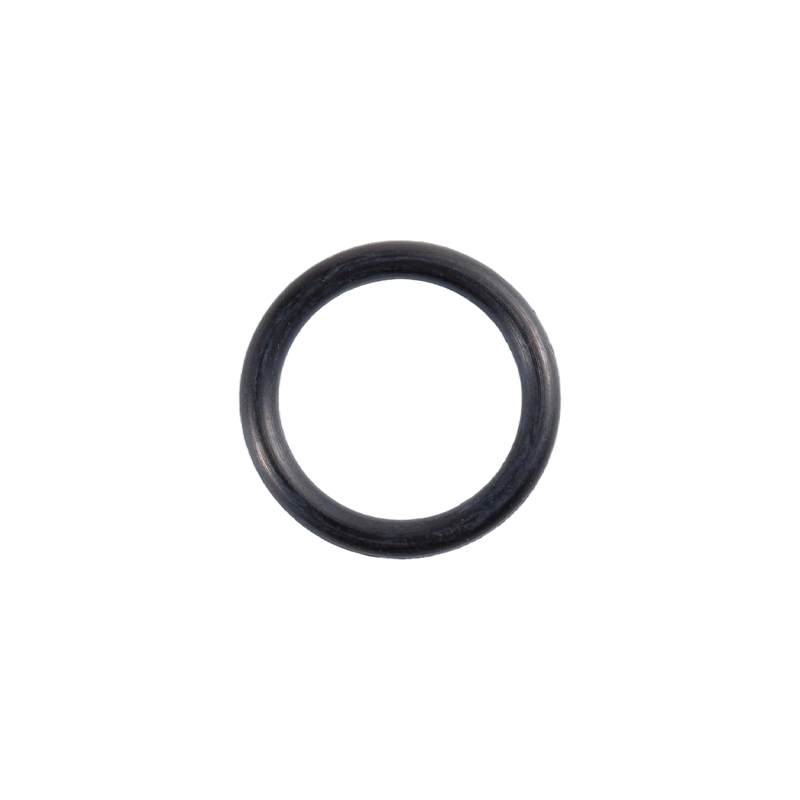
7.3mm Pneumatic-Grade Seal
Product Overview
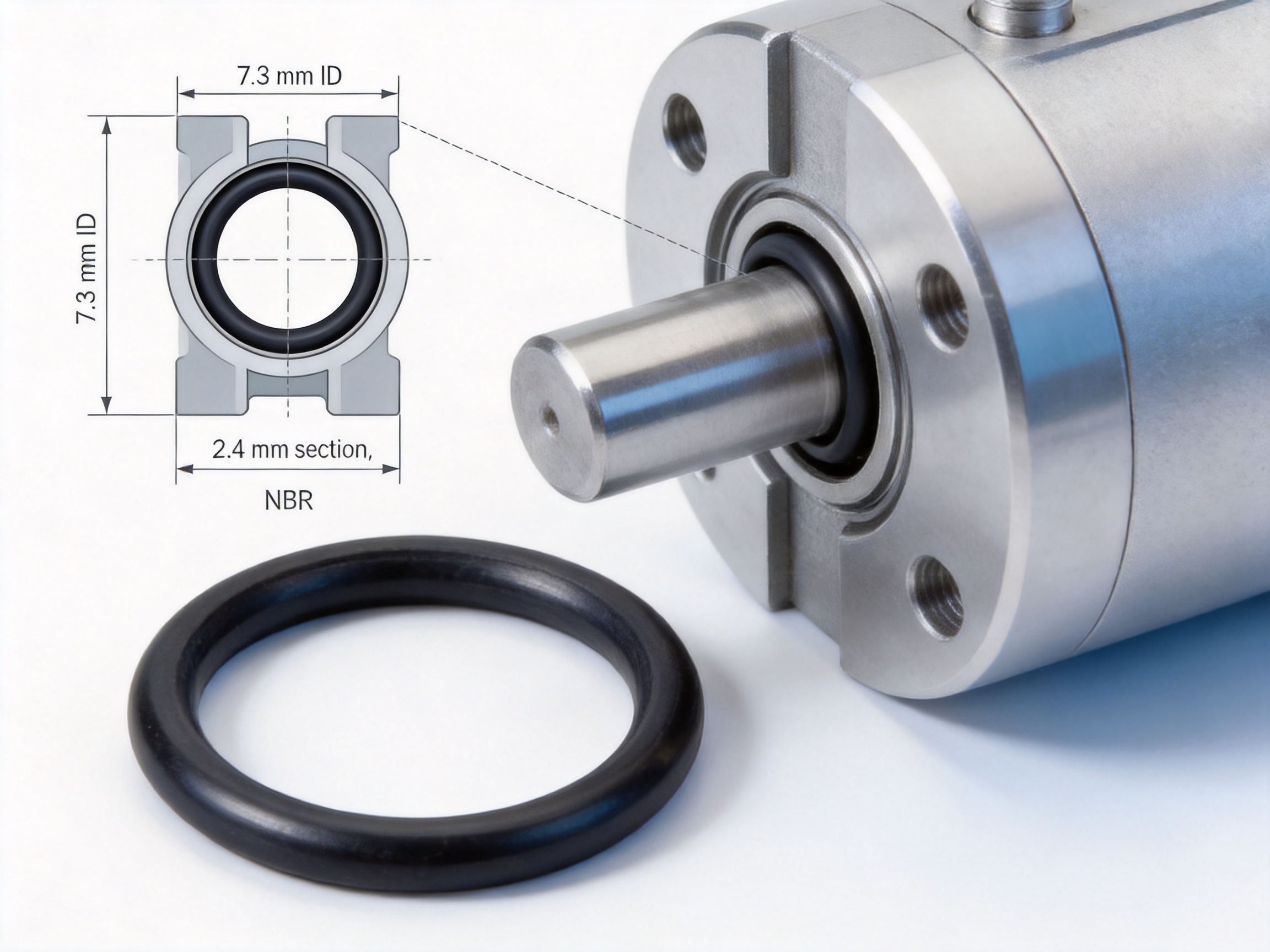
The A-4-004 is a round-section O-ring intended for pneumatic-grade sealing applications. Its principal dimensions are an internal diameter of 7.3 mm and a wire diameter of 2.4 mm. These measurements define the ring’s basic geometry and influence how it fits into a gland, bore, piston, rod, valve, or other sealing interface.
| Specification | Product Information |
| Product name | 7.3 mm Pneumatic-Grade Seal |
| Product code | A-4-004 |
| Seal type | O-shaped oil seal ring |
| Internal diameter | 7.3 mm |
| Wire diameter | 2.4 mm |
| Material | NBR, nitrile rubber |
| Primary design purpose | Pneumatic actuator sealing |
| Key performance objectives | Gas barrier, airtightness, volumetric stability, and controlled compression behavior |
The 7.3 mm internal diameter is suitable for assemblies that require a compact sealing element around a correspondingly sized shaft, piston, plug, or cylindrical interface. The 2.4 mm wire diameter provides the cross-sectional body needed to create a sealing line when the ring is compressed inside a correctly designed gland. Because the internal diameter and wire diameter work together, both dimensions should be considered during installation and design review.
A seal should not be evaluated by internal diameter alone. The mating groove, surface finish, clearance, pressure direction, expected movement, temperature range, lubrication conditions, and assembly method all affect final performance. A correctly manufactured ring can still fail if it is installed in an unsuitable gland or exposed to conditions beyond the capabilities of its material. The product’s value is therefore strongest when it is integrated into a properly engineered sealing system.
Why Pneumatic Applications Require Specialized Sealing
Pneumatic equipment uses compressed air or another gas to transmit force and motion. Compared with many liquid-based hydraulic systems, pneumatic systems can be more sensitive to leakage because gases are compressible and can escape through very small imperfections or gaps. A small leak may cause pressure decay, slower actuator movement, increased compressor demand, unstable positioning, or difficulty maintaining a required operating force.
Actuators also commonly operate through repeated reciprocating motion. During each cycle, the seal may experience sliding contact, deformation, friction, pressure changes, and exposure to lubricants or airborne contaminants. Repetition makes dimensional consistency especially important. A ring that performs well during initial assembly must also maintain its sealing geometry after many compression and movement cycles.
Pneumatic components are often designed with limited installation space. This creates a demand for compact seals that can deliver dependable contact without requiring excessive assembly force or oversized housing dimensions. The A-4-004 addresses this requirement through its compact 7.3 mm internal diameter and 2.4 mm cross-sectional size.
Another consideration is the relationship between sealing and friction. Excessive compression can improve initial resistance to leakage but may increase friction, heat generation, and wear. Insufficient compression can reduce friction but may permit leakage or allow the ring to move within the gland. A pneumatic-grade O-ring must therefore support a balanced design in which sealing force, sliding behavior, dimensional stability, and service life are considered together.
Material Performance of NBR
The A-4-004 is made from NBR, or nitrile rubber. NBR is widely used in sealing applications because it offers a practical combination of elasticity, oil resistance, abrasion resistance, and cost efficiency. These properties make it a common choice for industrial sealing, automotive components, pneumatic equipment, and general mechanical systems.
For pneumatic assemblies, NBR can provide the resilient recovery required to maintain contact with mating surfaces. When the ring is compressed, its elasticity helps generate a sealing force. When pressure changes or the assembly experiences small dimensional variations, the material can continue to conform to the sealing interface, provided that temperature, chemical exposure, and mechanical conditions remain suitable.
NBR is also valued for its resistance to many mineral oils and lubricants used in mechanical equipment. This can be important in pneumatic actuators and gas spring assemblies where a small amount of lubricant is present during assembly or operation. However, compatibility must always be confirmed against the specific lubricant, additive package, cleaning agent, and operating environment.
The performance of NBR is influenced by its formulation. Factors such as acrylonitrile content, curing system, hardness, filler selection, and post-curing conditions can affect flexibility, temperature performance, compression set, wear, and resistance to media. Consequently, the material designation alone is not a complete description of seal performance. Compound selection and process control are essential parts of product quality.
For applications involving higher temperatures, aggressive chemicals, fuels, ozone, or specialized gases, another elastomer may be more suitable. HNBR and FPM, for example, can be selected for certain demanding environments. The ability to evaluate alternative materials is one reason technical consultation is valuable when a customer’s working conditions extend beyond standard pneumatic service.
Key Product Advantages
Reliable Gas Barrier
The primary advantage of a pneumatic seal is its ability to limit gas passage across the sealing interface. The A-4-004 is developed with pneumatic use in mind, emphasizing a high gas barrier and airtightness. Its round cross-section supports uniform contact around a cylindrical sealing path when installed in a suitable gland.
Effective gas retention can improve actuator responsiveness and help maintain stable operating pressure. In equipment with multiple seals, reducing leakage at each interface can have a cumulative effect on energy use and operating consistency. A dependable seal may also reduce the need for frequent pressure compensation or compressor cycling.
Compact Geometry
The 7.3 mm internal diameter and 2.4 mm wire diameter provide a compact format for small actuators, valves, damper assemblies, and gas spring components. Compact sealing elements can help designers reduce the overall size of a mechanism, preserve space for other components, and achieve a cleaner arrangement in applications where installation room is limited.
Compact dimensions also support applications in furniture hardware, small mechanical controls, medical equipment, and appliance mechanisms. The suitability of the seal depends on the exact gland design and service conditions, but its size makes it relevant to a broad range of space-constrained assemblies.
Volumetric Stability
Volumetric stability refers to the ability of the elastomer to retain its intended dimensions and shape during service. Excessive swelling, shrinkage, or permanent deformation can change contact pressure and create a path for leakage. The A-4-004 is described as supporting superior volumetric stability, an important characteristic for pneumatic applications where dimensional changes may directly affect airtightness.
Stable volume helps the seal maintain predictable interaction with the groove and mating surface. It can also improve consistency between production batches when the material compound and curing process are carefully controlled. This is particularly valuable for manufacturers who need repeatable assembly behavior across large quantities of finished products.
Controlled Compression Behavior
A seal’s compression behavior affects both initial sealing and long-term performance. The A-4-004 is designed for optimized compression set performance in pneumatic service. Compression set occurs when an elastomer does not fully return to its original shape after being compressed for a period of time. If compression set becomes excessive, contact pressure may decrease and leakage may develop.
Good compression behavior helps the ring remain resilient after installation. This is important in assemblies that remain pressurized for long periods or experience repeated pressure cycles. It may also contribute to more stable performance during storage, transportation, and service, provided that the environmental conditions remain within the material’s suitable range.
Adaptability to Repeated Operation
Pneumatic actuators commonly perform many cycles during their service life. A seal must tolerate the mechanical action associated with movement while maintaining its ability to conform to the sealing surface. NBR’s elasticity and abrasion resistance can support this requirement when the surface finish, lubrication, clearance, and pressure conditions are properly controlled.
The A-4-004’s intended pneumatic application allows it to be evaluated as part of a complete dynamic sealing system. Buyers should consider whether their design involves static sealing, reciprocating movement, rotary movement, or a combination of conditions. The same O-ring profile may perform differently depending on how it moves and how it is supported.
Advantages Compared with Generic Competitor Seals
Many standard O-rings may share similar dimensions, but dimensional similarity does not necessarily mean equivalent pneumatic performance. A generic ring may be manufactured for broad industrial use without being optimized for gas retention, repeated actuator cycling, or the specific compression behavior required by a compact pneumatic assembly.
The A-4-004 offers a more application-focused proposition. It is identified as a pneumatic-grade product, not simply as an O-ring with a matching internal diameter. This distinction encourages evaluation of gas barrier performance, dimensional stability, material suitability, and compression behavior rather than relying solely on nominal size.
One potential advantage over lower-cost, less controlled alternatives is improved batch consistency. If the ring dimensions vary significantly from piece to piece, assembly force and sealing pressure may also vary. A professional production process with controlled molding, curing, trimming, inspection, and packaging can reduce these variations and support more predictable customer assembly.
Another advantage is technical support. Generic products are often sold as catalog items with limited assistance regarding gland design, material compatibility, or application testing. A specialized sealing manufacturer can provide product design, testing, and technical consultation. This becomes particularly valuable when a customer is developing a new actuator, revising a sealing interface, or troubleshooting leakage in an existing product.
The product also offers a practical balance between performance and material economy. NBR is generally more economical than some specialty elastomers while still providing useful oil resistance, elasticity, and mechanical durability. For applications that do not require the extreme chemical or temperature resistance of a premium material, NBR can help control component cost without treating sealing reliability as an afterthought.
Compared with oversized seals, the compact format may help reduce housing dimensions and material consumption. Compared with undersized or poorly matched rings, the specified 7.3 mm by 2.4 mm geometry offers a defined basis for gland design and product qualification. The most appropriate comparison is therefore not simply price per ring, but total performance, assembly consistency, maintenance risk, and technical support.
Manufacturing Process and Quality Control
The performance of an elastomeric seal depends heavily on manufacturing discipline. A high-quality design can be undermined by poor compound mixing, inconsistent molding pressure, inaccurate tooling, incomplete curing, excessive flash, contamination, or inadequate inspection. For this reason, the manufacturing process must be viewed as a sequence of controlled operations rather than a single molding step.
Material Preparation
Production begins with the selection and preparation of the NBR compound. Raw materials and compounding ingredients must be handled in a controlled manner so that the final rubber has consistent processing and performance characteristics. The compound must be mixed sufficiently to distribute fillers, curing agents, plasticizers, stabilizers, and other components throughout the rubber matrix.
Uniform mixing helps reduce local differences in hardness, elasticity, and cure response. It also supports consistent molding behavior. If material preparation is not controlled, finished seals may show variation in surface quality, compression response, or dimensional recovery.
Precision Tooling
The molding tool determines much of the seal’s geometry. For a small O-ring such as the A-4-004, tool accuracy is important because minor deviations may represent a meaningful percentage of the 2.4 mm wire diameter. Tool design must account for shrinkage, parting lines, cavity filling, demolding, and the requirements for trimming or finishing.
Advanced production equipment can support more stable temperature, pressure, and timing during the molding cycle. Consistent process parameters help ensure that the ring forms evenly and that the material reaches the required cure state throughout the cross-section.
Compression Molding or Related Forming Operations
During molding, the prepared NBR material is shaped within the tool under controlled heat and pressure. The objective is to fill the cavity properly, achieve the intended cross-section, and cure the compound without creating unacceptable defects. Process control is especially important for pneumatic seals because surface discontinuities, incomplete filling, or excessive flash may interfere with assembly and leakage performance.
The curing stage establishes the elastomer’s final network structure. Under-cured material may lack strength or resilience, while over-curing can affect flexibility and long-term recovery. A stable process window helps deliver a balanced combination of elasticity, hardness, tensile behavior, and compression-set resistance.
Deflashing and Surface Finishing
After molding, excess material at the parting line or gate area may need to be removed. Deflashing must be performed carefully. Excessive trimming can damage the sealing surface, while insufficient trimming can interfere with installation or create a local irregularity.
Surface quality matters because the O-ring must create continuous contact with the mating surface. Cuts, nicks, cracks, blisters, embedded particles, or severe mold marks may become leakage paths. Visual inspection and appropriate dimensional checks are therefore important stages in production.
Dimensional Inspection
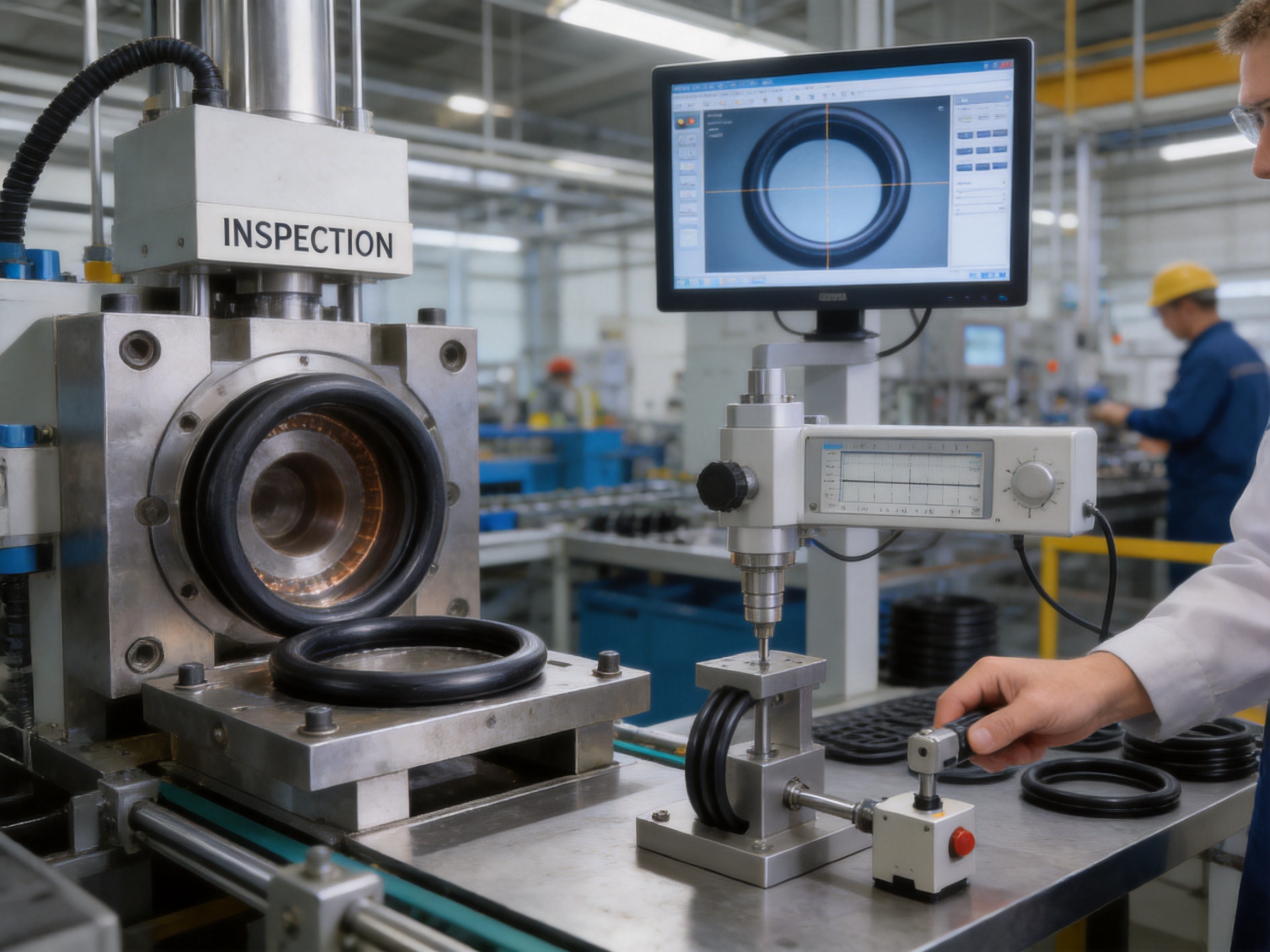
For the A-4-004, inspection should focus on internal diameter, wire diameter, roundness, flash, and visible defects. Measurement methods must be appropriate for soft elastomeric products because excessive measuring force can distort the ring and produce misleading results.
Consistent dimensional inspection supports better assembly control. When the internal diameter and wire diameter remain within the approved range, the customer can more confidently establish insertion methods, compression levels, and automated assembly settings. Repeatable dimensions are also valuable when the seal is installed alongside other precision components.
Performance Testing
Testing can be used to evaluate compression behavior, leakage resistance, material compatibility, and dimensional recovery. The exact test program depends on the customer’s application and performance requirements. Static and dynamic sealing tests may be considered, as well as aging, media exposure, temperature conditioning, and repeated cycling.
A manufacturer with research and development capability can use test results to refine material selection, geometry, and process parameters. This is more effective than treating every sealing problem as a purchasing issue. When the seal is evaluated as part of the complete assembly, the manufacturer can better identify whether the cause of leakage is material, design, surface finish, clearance, installation, or operating condition.
Research and Development Strengths
A specialized sealing company’s research and development capability is an important advantage for customers with demanding or nonstandard requirements. Product development may involve choosing an elastomer, adjusting the cross-section, optimizing a groove fit, improving compression behavior, or adapting a seal to a new actuator design.
The company behind the A-4-004 focuses on sealing technology for gas springs, dampers, and related O-ring products. This application focus provides a foundation for understanding the practical requirements of compact pressure-containing mechanisms. Gas springs and dampers often require stable sealing under repeated movement, changing pressure, and restricted installation conditions.
Research and development is not limited to creating a new part number. It can also involve improving an existing product’s consistency, adapting it to a customer’s equipment, or identifying a more appropriate compound for a particular environment. A manufacturer with technical personnel and testing capability can support development decisions before large-scale production begins.
Early technical consultation may reduce the risk of selecting a ring that fits nominally but performs poorly in service. Important topics can include pressure level, movement type, temperature range, lubricant, gas medium, gland dimensions, surface roughness, clearance, installation method, and expected cycle count. Addressing these factors early can reduce redesign, field leakage, and maintenance costs.
Customization and Engineering Support
Standardized products are valuable because they simplify purchasing and replacement. However, not every machine uses a standard gland or operates under standard conditions. Customization may be necessary when the available installation space is restricted, the mating hardware has unusual dimensions, or the operating environment requires a special compound.
Customization can include changes to internal diameter, wire diameter, hardness, material formulation, color identification, packaging, inspection criteria, or production documentation. Any change should be evaluated carefully because altering one parameter may affect compression, friction, assembly force, or leakage performance.
The A-4-004 can serve as a reference point for customers who need a compact pneumatic O-ring. If the 7.3 mm by 2.4 mm configuration is close to the required design but not an exact match, technical discussion can determine whether the existing product is suitable or whether an adjusted configuration should be developed.
Technical consultation can also assist customers with failure analysis. For example, leakage may result from an incorrect gland volume rather than from the ring material. Spiral twisting may be caused by installation technique, insufficient lubrication, or excessive dynamic speed. Extrusion may be associated with clearance and pressure rather than a fundamental defect in the seal. A structured engineering review helps separate these causes.
Application Areas
Pneumatic Actuators
Pneumatic actuators require seals around pistons, rods, valves, or end caps to retain compressed gas and guide motion. The A-4-004 is specifically developed for pneumatic actuator applications, where airtightness and controlled compression are central performance requirements.
In small actuators, the compact dimensions may help designers maintain a reduced external profile. The NBR material can provide a practical solution where the working environment includes compatible lubricants and moderate operating conditions.
Gas Springs
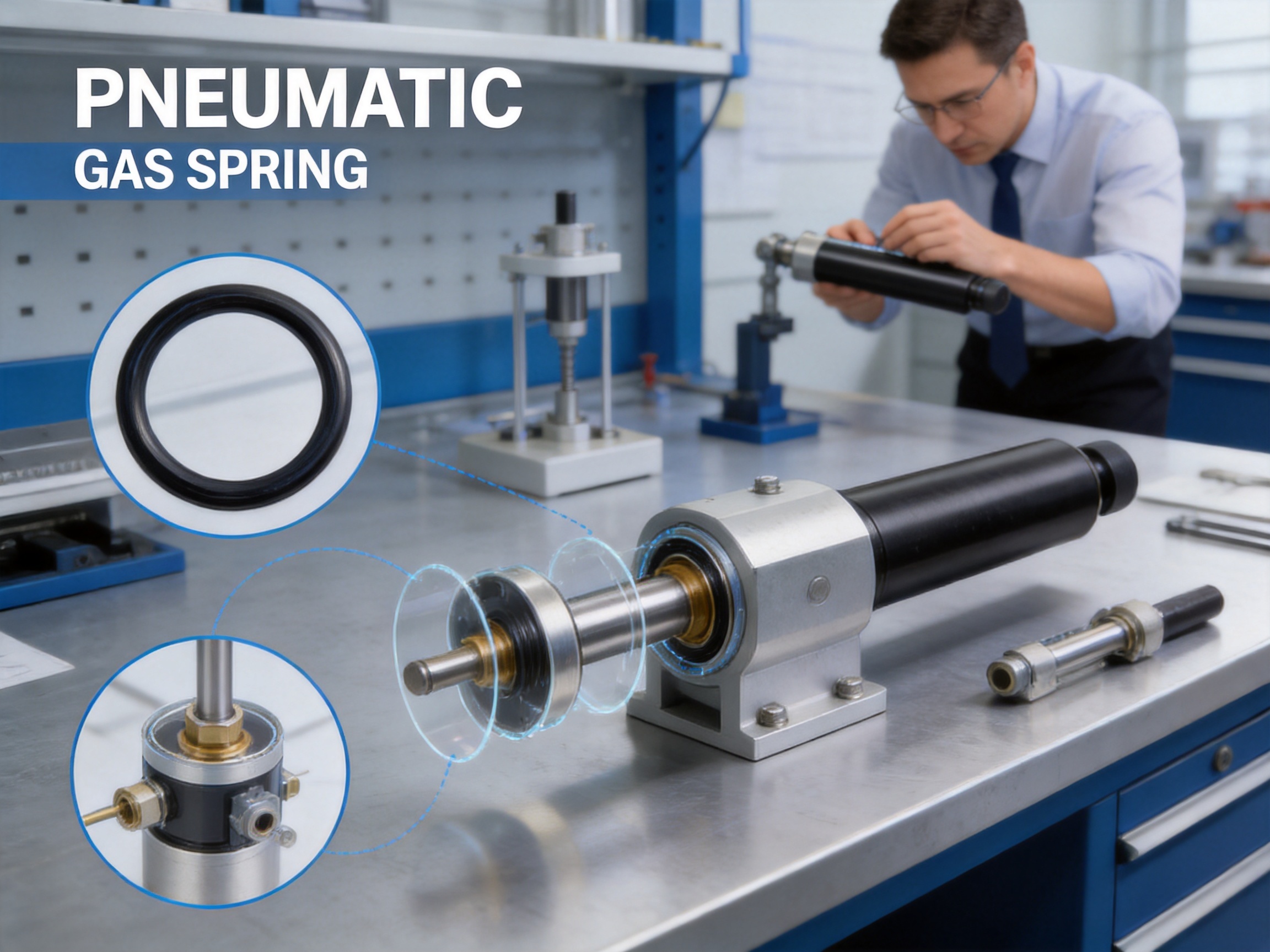
Gas springs use pressurized gas to provide controlled force for lifting, supporting, or positioning. Sealing quality affects force retention, service life, and user safety. A compact O-ring may be used in an internal sealing arrangement, depending on the specific gas spring architecture and pressure conditions.
Gas spring manufacturers should validate the seal under the actual pressure, temperature, movement, lubricant, and storage conditions of the final product. NBR selection may be appropriate for some designs, while other applications may require a different elastomer.
Dampers
Dampers control motion by restricting movement and dissipating energy. Their sealing systems must help retain the working medium and prevent leakage during repeated movement. An O-ring with stable dimensions and appropriate compression behavior can contribute to consistent damping performance.
Because damper designs vary substantially, the ring should be validated in the complete assembly. Dynamic speed, fluid type, pressure, temperature, and surface finish all influence results.
Furniture Hardware
Gas-assisted furniture mechanisms, adjustable supports, and compact lifting systems may use small pneumatic or gas spring components. In these products, smooth operation, compact size, and reliable pressure retention are often important. The A-4-004 may be considered where its dimensions and NBR compatibility match the design requirements.
Home Appliances and Medical Equipment
Small actuators, valves, dampers, and control mechanisms can be found in home appliances and medical equipment. Sealing requirements in these sectors vary widely. Cleanliness, low leakage, material documentation, and compatibility with cleaning agents may be especially important in medical-related applications.
Before use in a regulated or sensitive product, customers should establish their own material, validation, traceability, and compliance requirements. Product selection should be based on the complete application specification rather than size alone.
Installation Recommendations
Correct installation is essential to obtaining the intended performance from any O-ring. Before assembly, the groove and mating surfaces should be clean, free from sharp edges, and free from metal chips, dust, or other contaminants. The ring should be inspected for cuts, cracks, distortion, or surface damage.
The sealing groove should be designed with suitable dimensions and tolerances. Excessive compression can increase friction and accelerate wear, while insufficient compression may reduce airtightness. The groove should also provide enough space for the elastomer to deform without being excessively restricted.
Where compatible with the NBR compound and working medium, a suitable lubricant may help reduce assembly damage and friction. The lubricant should be verified for chemical compatibility and should not create an unacceptable effect on the finished product.
During installation, the ring should not be stretched beyond its recommended limits or twisted into a spiral. Tools with sharp edges should be avoided. If the ring passes over threads, ports, grooves, or other features, protective sleeves or carefully controlled assembly methods may be required.
For dynamic applications, the mating surface should have an appropriate finish and should be free from scratches running across the sealing path. Excessive clearance can increase the risk of extrusion, especially under pressure. These design details should be reviewed before production release.
Selection and Validation Checklist
Before approving the A-4-004 for a new application, the engineering team should document the operating conditions. This provides a clear basis for deciding whether the specified NBR O-ring is suitable.
| Evaluation area | Questions to review |
| Geometry | Does the 7.3 mm internal diameter and 2.4 mm wire diameter match the shaft, bore, piston, or groove design? |
| Motion | Is the seal static, reciprocating, oscillating, or rotary? |
| Pressure | What are the normal, peak, and transient pressure conditions? |
| Temperature | What temperatures occur during operation, storage, transport, and cleaning? |
| Medium | Is the seal exposed to air, nitrogen, oil, grease, cleaning chemicals, or other media? |
| Surface condition | Are the sealing surfaces properly finished and free from scratches or contamination? |
| Clearance | Is the extrusion gap controlled for the expected pressure and material hardness? |
| Assembly | Can the ring be installed without twisting, cutting, stretching, or contamination? |
| Validation | Have leakage, cycling, aging, and compatibility tests been completed? |
This checklist helps prevent a common purchasing error: assuming that a ring is suitable because its nominal size matches. A successful seal is the result of compatibility between the ring, the gland, the mating components, the working medium, and the operating cycle.
Company Manufacturing and Service Capabilities
The manufacturer of the A-4-004 is a high-tech sealing enterprise founded in 2019 and headquartered in Anhui, China. Its primary focus is the research, development, and application of sealing technology for gas springs, dampers, and related O-ring products.
The company combines research and development capabilities with production equipment and a professional technical service team. This combination is important because customers often need more than a molded rubber part. They may require assistance with product design, prototype evaluation, material selection, testing, technical consultation, and production adaptation.
Its products are used in automotive, furniture, home appliance, medical equipment, construction, and other industries. These sectors involve different expectations for size, durability, appearance, cleanliness, operating temperature, and documentation. Experience across varied applications can help a manufacturer understand how sealing requirements change from one product category to another.
The company also provides customized sealing solutions. Custom work may involve design support, testing, and technical consultation. This allows customers to engage with a supplier during the development stage rather than waiting until a finished design experiences leakage or assembly problems.
A professional technical service team can support communication between purchasing departments, mechanical designers, quality engineers, and production personnel. Clear communication is particularly important for O-rings because terms such as diameter, hardness, compression, groove size, and material grade must be interpreted consistently.
The company’s stated philosophy emphasizes people-oriented development, innovation, and the pursuit of excellence. In practical terms, these principles can be reflected through attention to process control, product improvement, technical responsiveness, and long-term customer support. For buyers, the most useful measure is how effectively these principles translate into repeatable product quality and application assistance.
Quality, Supply, and Business Value
For industrial buyers, the value of an O-ring extends beyond its unit price. A low-cost component that causes leakage, rework, production stoppage, or field failure may create a much higher total cost. A supplier that supports consistent production and technical problem solving can contribute to lower risk throughout the product life cycle.
Stable supply is also important. Once a seal is qualified in an actuator or damper, replacing it with an apparently similar product may change friction, compression, leakage, or service life. Consistent manufacturing and clear product identification help customers manage repeat orders and replacement requirements.
The A-4-004 product code provides a clear reference for purchasing and engineering communication. Buyers can use the code together with the 7.3 mm internal diameter, 2.4 mm wire diameter, and NBR material description when preparing specifications or discussing future orders.
Packaging and storage should also be considered. Elastomeric products should generally be protected from direct sunlight, ozone-generating equipment, excessive heat, contamination, and unnecessary deformation. Appropriate storage conditions can help preserve the ring’s original properties before installation.
How to Compare Suppliers
When comparing the A-4-004 with products from other suppliers, buyers should request more than a nominal size and price. A useful comparison should include material information, dimensional tolerances, inspection practices, production capability, sample availability, testing support, and response to technical questions.
Suppliers should be evaluated on their ability to maintain consistent dimensions and surface quality. They should also be able to explain how they handle material control, molding, curing, deflashing, inspection, packaging, and customer complaints. Transparent communication is a sign that the supplier understands the relationship between manufacturing process and sealing performance.
Another comparison point is development support. A supplier that can help with gland design, prototype testing, alternative materials, and failure analysis may provide greater value than a supplier that only ships standard components. This is particularly true for original equipment manufacturers developing new pneumatic products.
Delivery capability and production flexibility may also matter. Some customers need regular high-volume supply, while others need prototypes, trial batches, or customized sizes. A manufacturer with both standard products and development capability can potentially support the customer from early design through mature production.
Frequently Asked Questions
What is the A-4-004 seal?
The A-4-004 is a 7.3 mm pneumatic-grade O-ring seal. It has a 7.3 mm internal diameter, a 2.4 mm wire diameter, and is made from NBR nitrile rubber. It is designed primarily for pneumatic actuators and related compact sealing applications.
What does the 7.3 mm dimension represent?
The 7.3 mm dimension represents the internal diameter of the O-ring. It should be considered together with the 2.4 mm wire diameter and the dimensions of the mating groove or shaft. A nominal internal diameter by itself does not determine whether the ring is suitable for a specific assembly.
What does the 2.4 mm dimension represent?
The 2.4 mm dimension represents the wire diameter, also called the cross-sectional diameter. This dimension affects groove fill, compression, sealing force, friction, and the amount of deformation available during installation.
Why is NBR used for this product?
NBR is widely used because it offers useful elasticity, oil and lubricant resistance, abrasion resistance, and cost efficiency. It is suitable for many pneumatic and mechanical applications, although the exact compound must be matched to the temperature, pressure, gas, lubricant, and chemical environment.
Can this seal be used in every pneumatic actuator?
No. Suitability depends on the actuator’s gland design, pressure, temperature, movement, surface finish, clearance, lubricant, and cycle requirements. The product is developed for pneumatic actuator applications, but validation in the complete assembly is recommended before mass production.
Is the A-4-004 suitable for dynamic sealing?
It may be suitable for certain reciprocating pneumatic applications when the groove, surface finish, lubrication, clearance, speed, and pressure are properly controlled. Dynamic applications should be tested because movement can produce more friction and wear than static sealing.
What makes a pneumatic-grade O-ring different from a generic O-ring?
A pneumatic-grade O-ring is selected and evaluated with gas retention, airtightness, compression behavior, dimensional stability, and repeated actuator operation in mind. A generic O-ring may have the same nominal dimensions but may not have been optimized or validated for the same performance objectives.
Can the manufacturer provide customized sealing solutions?
Yes. The manufacturer provides customized sealing solutions that can include product design, testing, and technical consultation. Customization may involve dimensions, material selection, performance requirements, or application-specific development.
What information should a buyer provide when requesting a quotation?
A buyer should provide the product code or dimensions, required quantity, application, pressure, temperature, movement type, working medium, lubricant, gland details, expected service life, packaging requirements, and any inspection or documentation requirements.
How should the seal be stored before use?
The seal should be stored in a clean, dry environment away from direct sunlight, ozone sources, excessive heat, sharp objects, and unnecessary compression or stretching. The customer should follow its internal elastomer storage procedures and inspect products before assembly.
What should be done if leakage occurs after installation?
The investigation should consider ring damage, incorrect dimensions, improper compression, twisting, contamination, surface scratches, excessive clearance, pressure spikes, incompatible media, and assembly tools. It is useful to involve the manufacturer’s technical team so that the failure can be assessed systematically.
Conclusion
The 7.3 mm Pneumatic-Grade Seal is a compact NBR O-ring designed for pneumatic actuators and related sealing applications. Its 7.3 mm internal diameter and 2.4 mm wire diameter provide a defined configuration for small mechanical assemblies, while its pneumatic-oriented design emphasizes gas barrier performance, airtightness, volumetric stability, and controlled compression behavior.
Its principal advantages over less specialized alternatives include application-focused design, practical NBR performance, compact geometry, potential batch consistency, and access to technical support. These advantages are most meaningful when the seal is installed in a correctly designed gland and validated under actual pressure, temperature, movement, and media conditions.
The manufacturer’s strengths include research and development in gas spring and damper sealing, advanced production equipment, professional technical service, customized product development, and testing support. These capabilities allow the supplier to contribute not only a standard O-ring but also engineering assistance for customers facing complex sealing requirements.
For buyers, the best selection process combines dimensional review, material compatibility analysis, manufacturing evaluation, and application testing. When these factors are addressed together, the A-4-004 can provide a practical and reliable sealing option for compact pneumatic systems, gas springs, dampers, appliances, furniture mechanisms, automotive components, and other products requiring controlled gas retention.
References
1. Elastomeric sealing principles, including O-ring geometry, gland design, compression, and installation practice.
2. General engineering guidance for nitrile rubber compound selection and compatibility with oils, lubricants, gases, and industrial environments.
3. Technical literature on pneumatic actuator sealing, reciprocating motion, leakage control, and compression-set behavior.
4. General manufacturing practices for molded rubber products, including compound mixing, precision tooling, curing, deflashing, dimensional inspection, and visual quality control.
5. Product information for the A-4-004 7.3 mm Pneumatic-Grade Seal, including product dimensions, NBR material, application purpose, and product code.
Product: 7.3mm Pneumatic-Grade Seal

PREV:High-Temperature FPM Rotary Sealing Rings for Demanding Chemical and High-Speed Applications
NEXT:Micro Precision Pump Y-Seal for Low-Pressure Pneumatic and Damping Applications
NEXT:Micro Precision Pump Y-Seal for Low-Pressure Pneumatic and Damping Applications



Want to know more
about us?
about us?

Precision sealing for gas springs and dampers. Durable, wear-resistant, and built for long-life performance in demanding applications.
Product Categories
Quick Links
Contact Us
-
Email: jns@jnsseals.cn

-
Email: LouZhuoyu@outlook.com
-
Manager Gong: +86-18563770820

-
Manager Wang: +8615357558902
-
No. 5, Meilin Avenue, Meilin Industrial Development Zone, Ningguo City, Anhui Province, China

